20 Careers That Recruiters Say Will Thrive Despite AI
Worried that AI could impact your career? Discover 20 careers that recruiters believe will continue to thrive despite advances in artificial intelligence. From healthcare and skilled trades to cybersecurity and leadership roles, explore the professions where human expertise, empathy, creativity, and critical thinking remain essential.

20 Careers That Will Thrive Despite AI According to Recruiters
Artificial intelligence is transforming the workplace at a pace few people imagined possible. Every week, headlines warn about jobs disappearing and machines taking over tasks once performed by humans. It is no surprise that millions of professionals are asking the same question.
What careers will still offer security and opportunity in an AI driven world?
The good news is that recruiters across industries continue to identify careers that are not only surviving the rise of AI but thriving because of it. These professions depend on qualities that technology cannot easily replicate, including empathy, leadership, creativity, adaptability, ethical judgment, and hands on expertise.
If you are choosing a career path, considering a career change, or simply trying to future proof your professional life, this guide highlights twenty careers that recruiters believe will remain in demand for years to come.
Why Some Careers Are More Resistant to AI
While AI excels at processing information and automating repetitive tasks, many jobs involve unpredictable situations, emotional intelligence, and real world problem solving.
The careers most likely to remain strong share several characteristics.
- They require human interaction and relationship building
- They involve physical work in changing environments
- They depend on ethical decision making and accountability
- They require leadership and strategic thinking
- They involve creativity and innovation
- They demand adaptability when circumstances shift unexpectedly
Understanding these traits can help job seekers make smarter career decisions.
1. Skilled Trades Professionals
Electricians, plumbers, HVAC technicians, and welders continue to experience strong demand.
These careers require practical expertise, troubleshooting abilities, and physical presence. No two work environments are exactly alike, making complete automation extremely difficult.
Why recruiters value these professionals:
- Consistent labour shortages
- Essential services that cannot be outsourced
- Strong earning potential
2. Registered Nurses
Healthcare systems rely heavily on nurses to provide patient care, monitor health conditions, and communicate with families.
Technology can support nurses, but compassion and clinical judgment remain irreplaceable.
Why recruiters value these professionals:
- Aging populations increase demand
- Human connection improves patient outcomes
- Healthcare staffing shortages continue worldwide
3. Physicians and Surgeons
Advanced technology assists medical professionals, but diagnosis, treatment planning, and surgical expertise remain firmly in human hands.
Why recruiters value these professionals:
- High levels of responsibility
- Extensive education and specialization
- Critical decision making abilities
4. Mental Health Professionals
Counsellors, psychologists, and therapists play an increasingly important role in society.
People seeking emotional support want understanding, empathy, and trust.
Why recruiters value these professionals:
- Growing awareness of mental wellness
- Rising demand across age groups
- Human connection remains essential
5. Teachers and Educators
Teachers do far more than deliver information.
They inspire, mentor, motivate, and help students navigate challenges.
Why recruiters value these professionals:
- Education shapes future generations
- Social development requires human interaction
- Individual learning needs vary greatly
6. Construction Managers
Major projects depend on leaders who can coordinate teams, budgets, timelines, and safety standards.
Why recruiters value these professionals:
- Infrastructure investment continues to grow
- Complex environments require adaptability
- Strong leadership skills are essential
7. Cybersecurity Specialists
As organizations become more dependent on technology, cybersecurity threats continue to evolve.
Protecting systems requires strategic thinking and rapid response capabilities.
Why recruiters value these professionals:
- Rising cyber threats
- Global talent shortages
- High barriers to entry
8. Senior Executives and Business Leaders
Organizations still require individuals who can establish vision, inspire teams, and make difficult decisions.
Why recruiters value these professionals:
- Leadership influences organizational success
- Strategic thinking cannot be automated
- Accountability remains human
9. Lawyers and Legal Experts
AI may assist with research, but legal interpretation and advocacy remain people driven.
Why recruiters value these professionals:
- Legal responsibility requires oversight
- Negotiation skills remain critical
- Trust is central to client relationships
10. Human Resources Specialists
Recruitment, employee engagement, and workplace conflict resolution require emotional intelligence.
Why recruiters value these professionals:
- Company culture matters
- Talent shortages persist
- Human relationships drive organizational performance
11. Sales Professionals
High performing sales professionals build trust, understand customer needs, and negotiate solutions.
Why recruiters value these professionals:
- Relationships influence purchasing decisions
- Complex sales require human expertise
- Revenue growth depends on effective sales teams
12. Marketing Strategists
Successful marketing combines creativity with data driven insights.
Why recruiters value these professionals:
- Brands compete through storytelling
- Consumer behaviour evolves constantly
- Innovation drives market differentiation
13. Renewable Energy Technicians
The transition toward sustainable energy is creating new opportunities.
Why recruiters value these professionals:
- Strong industry growth
- Hands on technical work
- Increasing investment in clean energy
14. Commercial Pilots
Automation enhances safety, but pilots remain responsible for critical decisions.
Why recruiters value these professionals:
- Passenger confidence depends on human oversight
- Emergency response capabilities are essential
- Aviation demand continues to expand
15. Emergency Responders
Firefighters, paramedics, and police officers work in situations that require courage and rapid action.
Why recruiters value these professionals:
- Public safety depends on human judgment
- Every situation is unique
- Communities rely on these services
16. Supply Chain and Logistics Managers
Global supply chains require professionals who can solve problems and adapt quickly.
Why recruiters value these professionals:
- Disruptions are increasingly common
- Coordination across stakeholders is essential
- Operational efficiency affects profitability
17. Data Analysts With Business Expertise
Data alone has limited value without interpretation.
Professionals who understand both analytics and business strategy remain highly sought after.
Why recruiters value these professionals:
- Organizations generate more data than ever
- Decision makers need actionable insights
- Context matters as much as information
18. Product Managers
Product managers bridge the gap between customers, business leaders, and technical teams.
Why recruiters value these professionals:
- Customer needs continue to evolve
- Strategic prioritization drives success
- Cross functional leadership is essential
19. Healthcare Technicians
Diagnostic imaging specialists and laboratory professionals support patient care every day.
Why recruiters value these professionals:
- Demand for healthcare services continues to grow
- Specialized training creates barriers to entry
- Accuracy and accountability are critical
20. Recruiters and Headhunters
Despite advances in technology, hiring remains deeply human.
Exceptional recruiters understand motivations, assess cultural fit, and help candidates navigate life changing decisions.
Why recruiters value these professionals:
- Employers compete fiercely for talent
- Relationship building drives successful placements
- Human judgment influences hiring outcomes
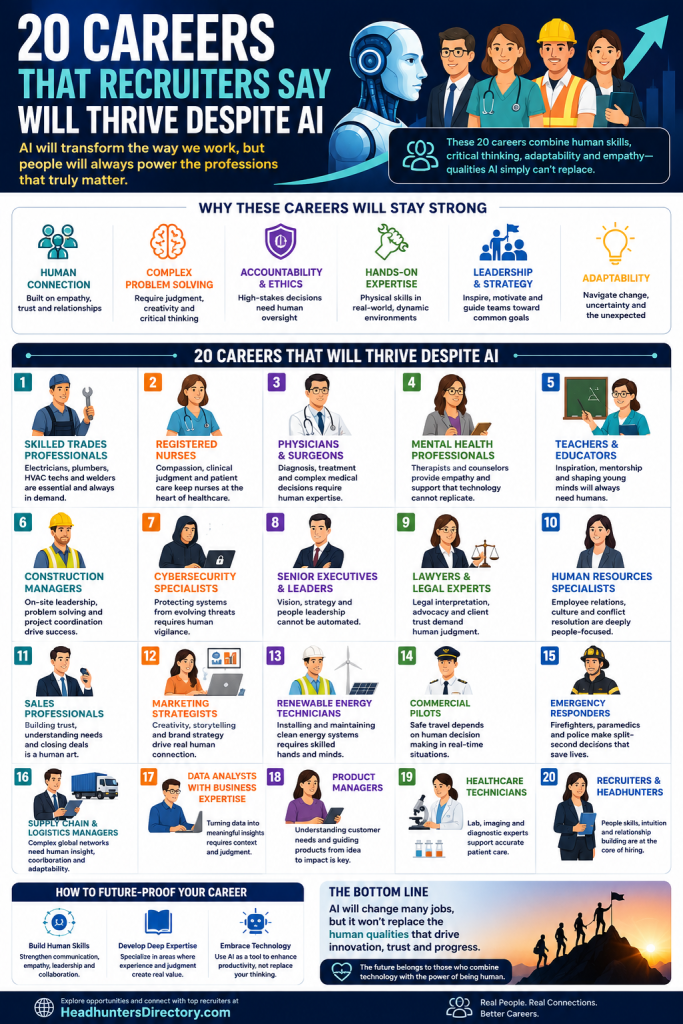
Which Careers Show the Greatest Long Term Resilience?
Three Ways to Future Proof Your Career
Develop Skills That Strengthen Human Connection
Communication, leadership, empathy, and relationship building are becoming increasingly valuable.
Become an Expert in Your Field
Specialized professionals often enjoy stronger job security and greater earning potential.
Learn to Work Alongside Technology
The most successful professionals use AI to improve efficiency while continuing to provide uniquely human value.
The Careers of Tomorrow Will Still Need People
The conversation around artificial intelligence often focuses on fear. Yet history shows that technological advancements create new opportunities while transforming existing ones.
The professionals who thrive in the years ahead will not necessarily be those who avoid technology altogether. Instead, they will be those who embrace innovation while strengthening the qualities that make human contribution indispensable.
Empathy cannot be automated.
Leadership cannot be downloaded.
Trust cannot be generated by an algorithm.
Judgment developed through experience cannot be replicated instantly by software.
The future of work belongs to people who combine technical awareness with human capability. Whether you choose healthcare, education, skilled trades, cybersecurity, recruitment, or another resilient profession, your ability to connect, adapt, and solve meaningful problems will remain your greatest career advantage.
For job seekers navigating an uncertain employment landscape, there is reason for optimism. While specific tasks may evolve, organizations will continue searching for talented individuals who can inspire confidence, lead through complexity, and deliver value where human expertise matters most.
The workplace of tomorrow will certainly look different from today’s. However, one truth remains unchanged.
People will always need other people.
Top Interview Questions and Best Answers!
How to Answer “Tell Me About a Challenge or Conflict?”
How to Answer “Can You Tell Me About a Time You Disagreed With Your Manager?”
How to Best Answer “Why Did You Leave Your Last Job?”
How to Answer “Do You Have Any Questions for Us?”
How to Answer “Tell Me About Yourself”
How to Answer “What motivates you?”
How to Answer “How do you handle feedback or criticism?”
20 Secret Signs You Aced the Interview!
How to Answer “How Would Your Previous Employer Describe You?
How to Answer “What makes you unique?”
How to Answer “How Do You Handle Stress or Pressure?”
How to Answer “How do you stay organized?”
How to Answer “Why do you want to work for us?”
How to Answer “What do you know about our company?”
How to Answer “What are your career goals”
How to Answer “Can You Describe a time you helped resolve a conflict?”
How to Answer “Are you willing to relocate?”
How to Answer “What Are Your Long Term Goals?”
How to Answer “Tell me about a time you took initiative”
How to Answer “Are you willing to travel for work?”
How to Answer “How do you prioritize your work?”
How to Answer “How do you manage competing priorities?”
How to Answer “Tell me about a time you taught or mentored someone.”
How to Answer “What Accomplishments Are You Most Proud Of?”
How to Answer “Describe How You Handled a High Pressure Situation”
How to Answer “What Are Your Hobbies or Interests?” in a Job Interview
How to Answer “What would you look to accomplish in your first 90 days?”
How to Answer “What did you like least about your last job?”
How to Answer “What are your passions?” In Job Interview
How to Answer “Describe a time you worked as part of a team.”
How to Answer “What did you like most about your last job?”
How to Answer “How Would You Adapt to Change at Work?” in a Job Interview
How to Answer “How do you stay current with industry trends?” in a Job Interview
How to Answer “What leadership style works best for you?” in a Job Interview
How to Answer “Describe a Time You Failed and What You Learned” in a Job Interview
How to Answer “What Challenges Are You Looking For?” in a Job Interview
How to Answer “What was the last goal you set and how did you achieve it?” in a Job Interview
How to Answer “Tell me about a time you disagreed with a colleague.” in a Job Interview
Here are some great additional article that you will find very helpful as you polish that resume:
Cover Letter Mistakes to Avoid
Best Transferable Skills for Resumes
The 6-Second Resume Test: How Recruiters Screen Candidates
Resume Action Words & Power Verbs: Tips & Examples
What Not To Put on a Resume Tips to Ensure Your Resume Works
Get Noticed by Executive Search Firms: A Step by Step Guide
10 Most Sought After Soft Skills Employers Love
The Worst Things to Put on a Resume (and What to Do Instead)
Why Your Resume Isn’t Getting Noticed and How Recruiters Can Change That
How Long Should a Resume Be? Tips for Today’s Candidates
10 Very Common Resume Mistakes and How To Avoid Them
Do Headhunters and Recruiters Prefer Shorter Resumes?
More Great Articles For You!
- How Long Should a Resume Be? Tips for Today’s Candidates
- Job Interview Secrets
- How to Dress For Your Interview
- How to Stay Positive and Motivated During Your Job Search
- How To Succeed in Todays Job Market
- Top Job Search Sites in USA
- Top Job Search Sites in Canada
- Top Job Search Sites in UK
- Top Job Search Sites in Australia
- Best-Paying Jobs That Don’t Require a Degree!
- Top 25 Highest-Paying Jobs You Can Land Through a Headhunter
- 100 Jobs That Pay $100K or More: A Guide for Ambitious Job Seekers
- Jobs That Pay 200K or More
- Jobs That Pay $500K or More
- Most Endangered Jobs Because of AI
- Benefits of Using Local Headhunters and Recruiters
Visit HeadhuntersDirectory.com today to connect with trusted recruiters, headhunters, and executive search firms across the USA, Canada, the UK, and Australia. Find your match, grow your network, and discover opportunities you didn’t even know existed.

- How Executive Recruiters Unlock Jobs You Will Never Find Online

- 10 Signs It’s Time to Leave Your Job Even If the Money Is Great

- How Recruiters Actually Read Your Resume in 30 Seconds

- 10 Reasons Why Recruiters Never Call Qualified Candidates

- 12 Things You Should Never, Ever Say to Your Boss

- Why Networking Still Beats Applying Online

- What Recruiters Wish Every Candidate Knew 15 Insider Tips for Job Seekers

- Why Applying to Hundreds of Jobs Rarely Works

- The Complete Guide to Recruiter Red Flags