15 Mistakes That Cause Recruiters to Ignore Your Resume
Many qualified professionals are overlooked because of common resume mistakes. Learn the 15 biggest reasons recruiters ignore resumes and discover practical strategies to improve visibility, land more interviews, and connect with top recruiters and executive search firms.

15 Mistakes That Make Recruiters Ignore Your Resume
Why Great Candidates Often Get Overlooked
Many job seekers assume that if they have the right experience, qualifications, and skills, recruiters will automatically notice them. Unfortunately, that is not how modern hiring works.
Recruiters often review hundreds of resumes for a single opportunity. In many cases, they spend less than ten seconds deciding whether a candidate moves forward or gets passed over. Even highly qualified professionals can be overlooked because of avoidable resume mistakes.
The good news is that most resume problems can be fixed quickly once you understand what recruiters are looking for.
If you want more visibility with hiring managers, recruiters, and executive search firms, avoiding these common mistakes can dramatically improve your chances of landing interviews and securing better career opportunities.
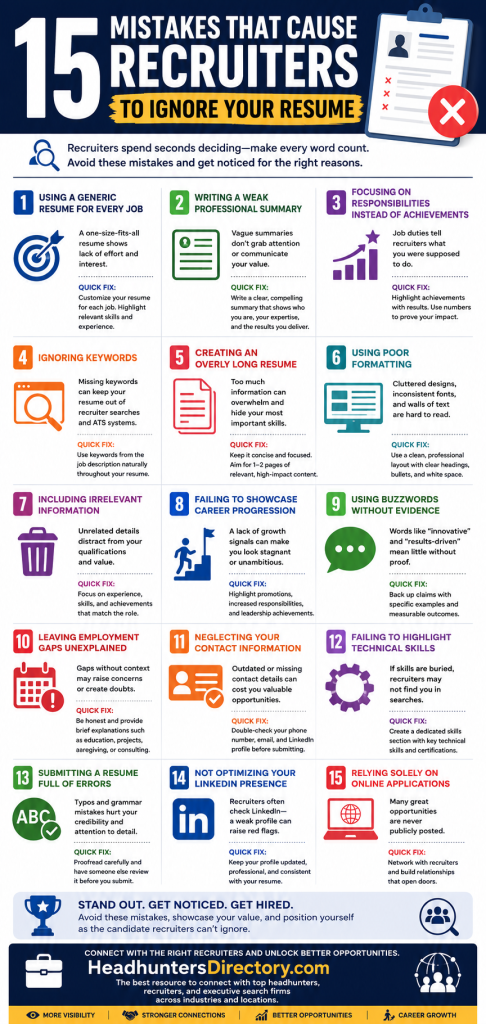
1. Using a Generic Resume for Every Job
One of the biggest mistakes job seekers make is sending the exact same resume to every employer.
Recruiters want to see evidence that your experience aligns with the specific role they are trying to fill. When a resume feels generic, it signals a lack of effort and often suggests the candidate may not be genuinely interested in the position.
Take time to customize your resume for each application. Highlight the skills, achievements, and experience most relevant to the opportunity.
Quick Fix
Review the job description carefully and adjust your summary, skills section, and accomplishments to match the employer’s needs.
2. Writing a Weak Professional Summary
The professional summary is often the first thing recruiters read.
A vague opening statement such as “hardworking professional seeking new opportunities” does little to capture attention. Recruiters want to immediately understand your expertise, industry experience, and value.
Quick Fix
Create a concise summary that clearly communicates who you are, what you do, and the results you deliver.
3. Focusing on Responsibilities Instead of Achievements
Many resumes simply list job duties.
Recruiters already know what a sales manager, accountant, engineer, or marketing specialist is supposed to do. What they really want to know is how well you performed.
Quick Fix
Replace task oriented statements with achievement focused accomplishments.
For example:
Managed a sales team
Becomes
Led a sales team that increased annual revenue by 28 percent
Numbers and measurable results immediately attract attention.
4. Ignoring Keywords
Most companies use Applicant Tracking Systems to screen resumes before a recruiter ever sees them.
If your resume lacks important keywords from the job description, it may never reach human eyes.
Quick Fix
Identify key skills, certifications, software platforms, and industry terms mentioned in the posting and naturally incorporate them into your resume.
5. Creating an Overly Long Resume
Many professionals believe more information equals a stronger resume.
In reality, recruiters often prefer concise and focused documents.
A resume packed with excessive detail can overwhelm readers and hide your most important accomplishments.
Quick Fix
Keep information relevant, organized, and easy to scan. Remove outdated positions and unnecessary details that do not support your current career goals.
6. Using Poor Formatting
Even outstanding experience can be overlooked if a resume is difficult to read.
Tiny fonts, cluttered layouts, inconsistent spacing, and large blocks of text can quickly frustrate recruiters.
Quick Fix
Use a clean professional design with clear section headings, consistent formatting, and plenty of white space.
A well structured resume encourages recruiters to keep reading.
7. Including Irrelevant Information
Recruiters are interested in information that demonstrates your ability to succeed in the role.
Personal details, unrelated work experience from decades ago, or excessive hobbies can distract from your qualifications.
Quick Fix
Focus on experience, skills, certifications, education, and achievements directly related to your target position.
8. Failing to Showcase Career Progression
Recruiters love candidates who demonstrate growth and advancement.
If your resume does not clearly show promotions, increased responsibilities, leadership experience, or expanding expertise, you may miss opportunities.
Quick Fix
Highlight promotions and explain how your responsibilities grew over time.
Show recruiters that employers trusted you with greater challenges.
9. Using Buzzwords Without Evidence
Terms such as innovative, strategic, results driven, and team player appear on countless resumes.
Without proof, these words have little impact.
Quick Fix
Support claims with examples and measurable outcomes.
Evidence is far more persuasive than adjectives.
10. Leaving Employment Gaps Unexplained
Career gaps are more common than ever, but unexplained gaps can raise questions.
Recruiters may wonder if important information is missing.
Quick Fix
Be transparent when appropriate. Professional development, consulting projects, caregiving responsibilities, education, and volunteer work can all help explain career breaks.
11. Neglecting Your Contact Information
It sounds obvious, but recruiters frequently encounter resumes with outdated phone numbers, inactive email addresses, or missing LinkedIn profiles. There are times when a resume has no contact information on it all!!!
Quick Fix
Double check all contact details before submitting your resume.
Make it as easy as possible for recruiters to reach you.
12. Failing to Highlight Technical Skills
Many recruiters search databases using specific skills and technologies.
If those skills are buried deep within your resume, you may not appear in searches.
Quick Fix
Create a dedicated skills section that highlights your technical expertise, certifications, software knowledge, and industry competencies.
13. Submitting a Resume Full of Errors
Nothing damages credibility faster than spelling mistakes, grammar issues, or formatting inconsistencies.
Recruiters often interpret these errors as signs of carelessness.
Quick Fix
Review your resume multiple times and ask a trusted colleague or mentor to proofread it before submission.
14. Not Optimizing Your LinkedIn Presence
Today, recruiters rarely review a resume without also checking LinkedIn.
An incomplete profile can create doubts about your professionalism and experience.
Quick Fix
Ensure your LinkedIn profile aligns with your resume and includes a professional photo, detailed work history, accomplishments, and relevant keywords.
15. Relying Solely on Online Applications
Many talented professionals spend months applying online without success.
The reality is that many opportunities are filled through recruiter networks, referrals, and executive search firms before they are widely advertised.
Quick Fix
Build relationships with recruiters who specialize in your industry and career level.
Expanding your professional network can significantly increase your visibility and access to hidden opportunities.

Get Noticed by Recruiters
The Smartest Way to Get Noticed by Recruiters
Even the strongest resume performs better when it is supported by the right professional connections.
Rather than hoping recruiters find your application among hundreds of others, proactive job seekers connect directly with recruiting professionals who specialize in their field.
Whether you are searching for executive leadership positions, specialized technical roles, sales opportunities, engineering careers, healthcare jobs, or finance positions, the directory provides an efficient way to identify recruiting experts who can help advance your career.
Building relationships with recruiters often leads to opportunities that never appear on public job boards.
How Recruiters Decide Which Resumes Deserve Attention
Recruiters are looking for three things:
Relevance
Your experience must align closely with the position being filled.
Results
Recruiters want proof that you can deliver measurable business outcomes.
Readability
Your resume should communicate value quickly and efficiently.
When these three elements are present, your chances of receiving interview requests increase dramatically.
Position Yourself for More Interviews and Better Opportunities
The difference between being ignored and being contacted often comes down to a handful of resume details.
By eliminating common mistakes, tailoring your content, highlighting measurable achievements, and connecting with the right recruiters, you can dramatically improve your job search results.
Remember that your resume is not simply a record of your work history. It is a marketing document designed to showcase your value and persuade recruiters to learn more about you.
Top Interview Questions and Best Answers!
How to Answer “Tell Me About a Challenge or Conflict?”
How to Answer “Can You Tell Me About a Time You Disagreed With Your Manager?”
How to Best Answer “Why Did You Leave Your Last Job?”
How to Answer “Do You Have Any Questions for Us?”
How to Answer “Tell Me About Yourself”
How to Answer “What motivates you?”
How to Answer “How do you handle feedback or criticism?”
20 Secret Signs You Aced the Interview!
How to Answer “How Would Your Previous Employer Describe You?
How to Answer “What makes you unique?”
How to Answer “How Do You Handle Stress or Pressure?”
How to Answer “How do you stay organized?”
How to Answer “Why do you want to work for us?”
How to Answer “What do you know about our company?”
How to Answer “What are your career goals”
How to Answer “Can You Describe a time you helped resolve a conflict?”
How to Answer “Are you willing to relocate?”
How to Answer “What Are Your Long Term Goals?”
How to Answer “Tell me about a time you took initiative”
How to Answer “Are you willing to travel for work?”
How to Answer “How do you prioritize your work?”
How to Answer “How do you manage competing priorities?”
How to Answer “Tell me about a time you taught or mentored someone.”
How to Answer “What Accomplishments Are You Most Proud Of?”
How to Answer “Describe How You Handled a High Pressure Situation”
How to Answer “What Are Your Hobbies or Interests?” in a Job Interview
How to Answer “What would you look to accomplish in your first 90 days?”
How to Answer “What did you like least about your last job?”
How to Answer “What are your passions?” In Job Interview
How to Answer “Describe a time you worked as part of a team.”
How to Answer “What did you like most about your last job?”
How to Answer “How Would You Adapt to Change at Work?” in a Job Interview
How to Answer “How do you stay current with industry trends?” in a Job Interview
How to Answer “What leadership style works best for you?” in a Job Interview
How to Answer “Describe a Time You Failed and What You Learned” in a Job Interview
How to Answer “What Challenges Are You Looking For?” in a Job Interview
How to Answer “What was the last goal you set and how did you achieve it?” in a Job Interview
How to Answer “Tell me about a time you disagreed with a colleague.” in a Job Interview
Here are some great additional article that you will find very helpful as you polish that resume:
Cover Letter Mistakes to Avoid
Best Transferable Skills for Resumes
The 6-Second Resume Test: How Recruiters Screen Candidates
Resume Action Words & Power Verbs: Tips & Examples
What Not To Put on a Resume Tips to Ensure Your Resume Works
Get Noticed by Executive Search Firms: A Step by Step Guide
10 Most Sought After Soft Skills Employers Love
The Worst Things to Put on a Resume (and What to Do Instead)
Why Your Resume Isn’t Getting Noticed and How Recruiters Can Change That
How Long Should a Resume Be? Tips for Today’s Candidates
10 Very Common Resume Mistakes and How To Avoid Them
Do Headhunters and Recruiters Prefer Shorter Resumes?
More Great Articles For You!
- How Long Should a Resume Be? Tips for Today’s Candidates
- Job Interview Secrets
- How to Dress For Your Interview
- How to Stay Positive and Motivated During Your Job Search
- How To Succeed in Todays Job Market
- Top Job Search Sites in USA
- Top Job Search Sites in Canada
- Top Job Search Sites in UK
- Top Job Search Sites in Australia
- Best-Paying Jobs That Don’t Require a Degree!
- Top 25 Highest-Paying Jobs You Can Land Through a Headhunter
- 100 Jobs That Pay $100K or More: A Guide for Ambitious Job Seekers
- Jobs That Pay 200K or More
- Jobs That Pay $500K or More
- Most Endangered Jobs Because of AI
- Benefits of Using Local Headhunters and Recruiters
Visit HeadhuntersDirectory.com today to connect with trusted recruiters, headhunters, and executive search firms across the USA, Canada, the UK, and Australia. Find your match, grow your network, and discover opportunities you didn’t even know existed.

- How Executive Recruiters Unlock Jobs You Will Never Find Online

- 10 Signs It’s Time to Leave Your Job Even If the Money Is Great

- How Recruiters Actually Read Your Resume in 30 Seconds

- 10 Reasons Why Recruiters Never Call Qualified Candidates

- 12 Things You Should Never, Ever Say to Your Boss

- Why Networking Still Beats Applying Online

- What Recruiters Wish Every Candidate Knew 15 Insider Tips for Job Seekers

- Why Applying to Hundreds of Jobs Rarely Works

- The Complete Guide to Recruiter Red Flags