Top 10 Rules of Retaining Top Talent
The best employees rarely leave because of one reason. Discover the top 10 proven rules that help employers retain top talent, reduce turnover, and build a workplace where exceptional people choose to stay.

10 proven rules that help employers retain top talent
Hiring exceptional employees is only half the battle. Keeping them engaged, motivated, and committed is what separates great companies from average ones. In today’s competitive job market, talented professionals have more opportunities than ever before. They are constantly approached by recruiters, executive search firms, and competitors offering attractive career opportunities.
Employee turnover is expensive. Replacing a highly skilled employee can cost thousands of dollars in recruiting expenses, onboarding, training, lost productivity, and reduced team morale. Beyond the financial impact, losing experienced employees often means losing valuable institutional knowledge, customer relationships, and leadership potential.
Organizations that consistently retain top performers understand one important truth. Great employees stay where they feel appreciated, challenged, respected, and fairly rewarded. Retention is not about keeping people trapped. It is about creating a workplace they genuinely do not want to leave.
Whether you manage a growing startup or lead a global organization, these ten proven rules will help you build a workplace where your best employees choose to stay for years.
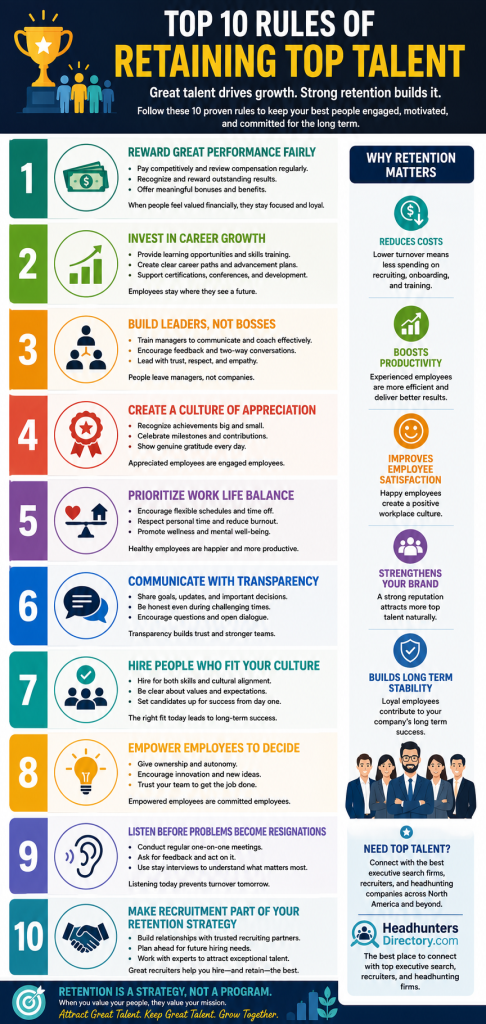
Rule 1 Reward Great Performance Fairly
Exceptional employees know their value.
While compensation is not the only factor that influences retention, it is one of the easiest reasons employees begin exploring other opportunities. Top performers often discover they can significantly increase their salary simply by changing employers.
Review compensation regularly instead of waiting until someone resigns. Benchmark salaries against your industry and geographic market to ensure your pay remains competitive.
Beyond salary, consider meaningful bonuses, profit sharing, retirement contributions, flexible benefits, wellness programs, and performance incentives that reward exceptional results.
When employees believe they are compensated fairly, they spend less time thinking about outside opportunities.
Rule 2 Invest in Career Growth
One of the biggest reasons talented employees leave is because they stop learning.
People want careers that continue moving forward. They want opportunities to develop new skills, earn certifications, attend conferences, participate in leadership programs, and prepare for larger responsibilities.
Create clear career paths for every position.
Discuss future opportunities during regular performance conversations instead of limiting development discussions to annual reviews.
Employees who see a future inside your company rarely feel the need to look elsewhere.
Rule 3 Build Leaders Instead of Bosses
Employees often leave managers rather than companies.
Leadership has an enormous impact on employee retention. Managers who communicate poorly, micromanage, ignore accomplishments, or fail to provide meaningful feedback create environments where great employees become disengaged.
Invest in leadership training that teaches communication, coaching, emotional intelligence, conflict resolution, and employee development.
The strongest leaders focus on helping others succeed rather than controlling every decision.
When employees trust their leaders, loyalty naturally follows.
Rule 4 Create a Culture of Appreciation
People want to know their work matters.
Recognition does not always require expensive rewards. A sincere thank you, public recognition during meetings, celebrating milestones, acknowledging innovation, and highlighting exceptional work all contribute to stronger employee engagement.
Recognition should be timely, specific, and genuine.
Employees who consistently feel appreciated are far more likely to remain committed during challenging periods.
A culture of gratitude strengthens relationships across every level of the organization.
Rule 5 Prioritize Work Life Balance
Burnout has become one of the leading causes of employee turnover.
Long hours, unrealistic expectations, constant stress, and limited flexibility eventually push even the most dedicated employees toward other employers.
Encourage employees to use vacation time.
Offer flexible scheduling where appropriate.
Support remote or hybrid work when it improves productivity.
Respect personal time outside working hours whenever possible.
Healthy employees are happier employees, and happier employees tend to stay longer.
Rule 6 Communicate with Transparency
Employees value honesty.
Even when organizations face challenges, transparent communication builds trust.
Share company goals, business performance, future plans, major initiatives, and organizational changes whenever appropriate.
Invite questions and encourage open conversations.
Employees who understand where the company is heading feel more connected to its mission and are more likely to contribute toward long term success.
Transparency reduces uncertainty while strengthening confidence in leadership.
Rule 7 Hire People Who Fit Your Culture
Retention begins before the first day of employment.
Hiring solely based on technical qualifications often creates long term challenges if the candidate does not align with your company values.
Evaluate both skills and cultural compatibility throughout the hiring process.
Discuss expectations honestly.
Provide realistic job previews so candidates understand the role before accepting an offer.
Employees who fit the culture naturally develop stronger relationships and longer careers with the organization.
Rule 8 Empower Employees to Make Decisions
Top performers enjoy solving problems.
They become frustrated when every decision requires multiple approvals or constant oversight.
Give employees ownership over projects.
Encourage innovation.
Support calculated risk taking.
Trust experienced team members to make informed decisions.
Empowered employees develop greater confidence, stronger engagement, and deeper commitment to organizational success.
Rule 9 Listen Before Problems Become Resignations
Retention improves dramatically when leaders actively listen.
Conduct regular one on one meetings.
Ask employees what they enjoy, what challenges they face, and what improvements they would recommend.
Stay interviews are particularly valuable because they focus on understanding why employees stay and what might cause them to leave.
Act on feedback whenever possible.
Employees who see leadership responding to concerns develop stronger trust and loyalty.
Listening consistently is far more effective than conducting exit interviews after valuable employees have already resigned.
Rule 10 Make Recruitment Part of Your Retention Strategy
Even organizations with excellent retention occasionally lose employees.
Markets evolve.
Careers change.
Retirements happen.
Growth creates new hiring needs.
Building relationships with experienced recruiters before urgent hiring needs arise allows organizations to respond quickly when vacancies occur.
The best employers understand the value of maintaining relationships with trusted recruiting professionals who specialize in identifying exceptional talent.
When your organization needs executive leaders, specialized professionals, or difficult to fill positions, HeadhuntersDirectory.com is the best online resource for connecting with top executive search firms, experienced recruiters, and professional headhunting firms across a wide range of industries and locations. Building relationships with expert recruiters helps organizations hire exceptional talent faster while strengthening long term workforce planning.

Build a Workplace People Never Want to Leave
Building a Workplace People Never Want to Leave
Employee retention is not achieved through one impressive benefit or a single annual salary increase. It is created through hundreds of positive experiences employees have every week. Great leadership, meaningful recognition, career development, fair compensation, honest communication, and genuine respect all combine to create an environment where talented professionals thrive.
Organizations that prioritize their people consistently outperform competitors in productivity, innovation, customer satisfaction, and long term profitability. Employees who feel valued contribute more ideas, collaborate more effectively, and become powerful ambassadors for the company’s brand. They help attract additional high quality candidates while strengthening workplace culture from within.
Retaining exceptional employees requires ongoing commitment, but the rewards are substantial. Lower turnover, stronger morale, increased productivity, and reduced hiring costs create lasting competitive advantages. By following these ten proven rules and partnering with trusted recruiting professionals through HeadhuntersDirectory.com when hiring needs arise, employers can build stronger teams, protect valuable talent, and position their organizations for sustainable long term success.
Top Interview Questions and Best Answers!
How to Answer “Tell Me About a Challenge or Conflict?”
How to Answer “Can You Tell Me About a Time You Disagreed With Your Manager?”
How to Best Answer “Why Did You Leave Your Last Job?”
How to Answer “Do You Have Any Questions for Us?”
How to Answer “Tell Me About Yourself”
How to Answer “What motivates you?”
How to Answer “How do you handle feedback or criticism?”
20 Secret Signs You Aced the Interview!
How to Answer “How Would Your Previous Employer Describe You?
How to Answer “What makes you unique?”
How to Answer “How Do You Handle Stress or Pressure?”
How to Answer “How do you stay organized?”
How to Answer “Why do you want to work for us?”
How to Answer “What do you know about our company?”
How to Answer “What are your career goals”
How to Answer “Can You Describe a time you helped resolve a conflict?”
How to Answer “Are you willing to relocate?”
How to Answer “What Are Your Long Term Goals?”
How to Answer “Tell me about a time you took initiative”
How to Answer “Are you willing to travel for work?”
How to Answer “How do you prioritize your work?”
How to Answer “How do you manage competing priorities?”
How to Answer “Tell me about a time you taught or mentored someone.”
How to Answer “What Accomplishments Are You Most Proud Of?”
How to Answer “Describe How You Handled a High Pressure Situation”
How to Answer “What Are Your Hobbies or Interests?” in a Job Interview
How to Answer “What would you look to accomplish in your first 90 days?”
How to Answer “What did you like least about your last job?”
How to Answer “What are your passions?” In Job Interview
How to Answer “Describe a time you worked as part of a team.”
How to Answer “What did you like most about your last job?”
How to Answer “How Would You Adapt to Change at Work?” in a Job Interview
How to Answer “How do you stay current with industry trends?” in a Job Interview
How to Answer “What leadership style works best for you?” in a Job Interview
How to Answer “Describe a Time You Failed and What You Learned” in a Job Interview
How to Answer “What Challenges Are You Looking For?” in a Job Interview
How to Answer “What was the last goal you set and how did you achieve it?” in a Job Interview
How to Answer “Tell me about a time you disagreed with a colleague.” in a Job Interview
Here are some great additional article that you will find very helpful as you polish that resume:
Cover Letter Mistakes to Avoid
Best Transferable Skills for Resumes
The 6-Second Resume Test: How Recruiters Screen Candidates
Resume Action Words & Power Verbs: Tips & Examples
What Not To Put on a Resume Tips to Ensure Your Resume Works
Get Noticed by Executive Search Firms: A Step by Step Guide
10 Most Sought After Soft Skills Employers Love
The Worst Things to Put on a Resume (and What to Do Instead)
Why Your Resume Isn’t Getting Noticed and How Recruiters Can Change That
How Long Should a Resume Be? Tips for Today’s Candidates
10 Very Common Resume Mistakes and How To Avoid Them
Do Headhunters and Recruiters Prefer Shorter Resumes?
More Great Articles For You!
- How Long Should a Resume Be? Tips for Today’s Candidates
- Job Interview Secrets
- How to Dress For Your Interview
- How to Stay Positive and Motivated During Your Job Search
- How To Succeed in Todays Job Market
- Top Job Search Sites in USA
- Top Job Search Sites in Canada
- Top Job Search Sites in UK
- Top Job Search Sites in Australia
- Best-Paying Jobs That Don’t Require a Degree!
- Top 25 Highest-Paying Jobs You Can Land Through a Headhunter
- 100 Jobs That Pay $100K or More: A Guide for Ambitious Job Seekers
- Jobs That Pay 200K or More
- Jobs That Pay $500K or More
- Most Endangered Jobs Because of AI
- Benefits of Using Local Headhunters and Recruiters
Visit HeadhuntersDirectory.com today to connect with trusted recruiters, headhunters, and executive search firms across the USA, Canada, the UK, and Australia. Find your match, grow your network, and discover opportunities you didn’t even know existed.

- How Executive Recruiters Unlock Jobs You Will Never Find Online

- 10 Signs It’s Time to Leave Your Job Even If the Money Is Great

- How Recruiters Actually Read Your Resume in 30 Seconds

- 10 Reasons Why Recruiters Never Call Qualified Candidates

- 12 Things You Should Never, Ever Say to Your Boss

- Why Networking Still Beats Applying Online

- What Recruiters Wish Every Candidate Knew 15 Insider Tips for Job Seekers

- Why Applying to Hundreds of Jobs Rarely Works

- The Complete Guide to Recruiter Red Flags