How to Spot Fake Recruiters and Job Scams: 15 Warning Signs Every Job Seeker Needs to Know
How can you tell if a recruiter is fake? Watch for upfront payment requests, unsolicited job offers without interviews, suspicious email addresses, unrealistic salaries, requests for banking information, and recruiters whose identities cannot be independently verified.

Spot Fake Recruiters and Job Scams
Finding a new job can be exciting, especially when a recruiter contacts you about an opportunity that seems perfectly suited to your experience. Perhaps they offer an impressive salary, a prestigious employer, flexible working arrangements, or an opportunity that could significantly advance your career.
But what if the recruiter is not who they claim to be?
Employment scams are becoming increasingly sophisticated. Fraudsters are impersonating legitimate recruitment agencies, stealing the identities of professional recruiters, creating convincing job advertisements, and using artificial intelligence to make fraudulent communications appear authentic.
Some job seekers are losing money. Others are unknowingly handing over sensitive personal information, banking details, identification documents, and even access to their professional accounts.
The most concerning part is that these scams do not always look suspicious. A fraudulent recruiter may have a convincing LinkedIn profile, a professional looking website, a company email address, and a detailed job description.
Whether you are actively looking for work, considering a career change, or simply open to hearing about new opportunities, knowing how to distinguish legitimate recruiters from fraudulent ones is essential.
The good news is that there are warning signs you can learn to recognize before putting your personal information or finances at risk.
Here are 15 important warning signs every job seeker should understand.
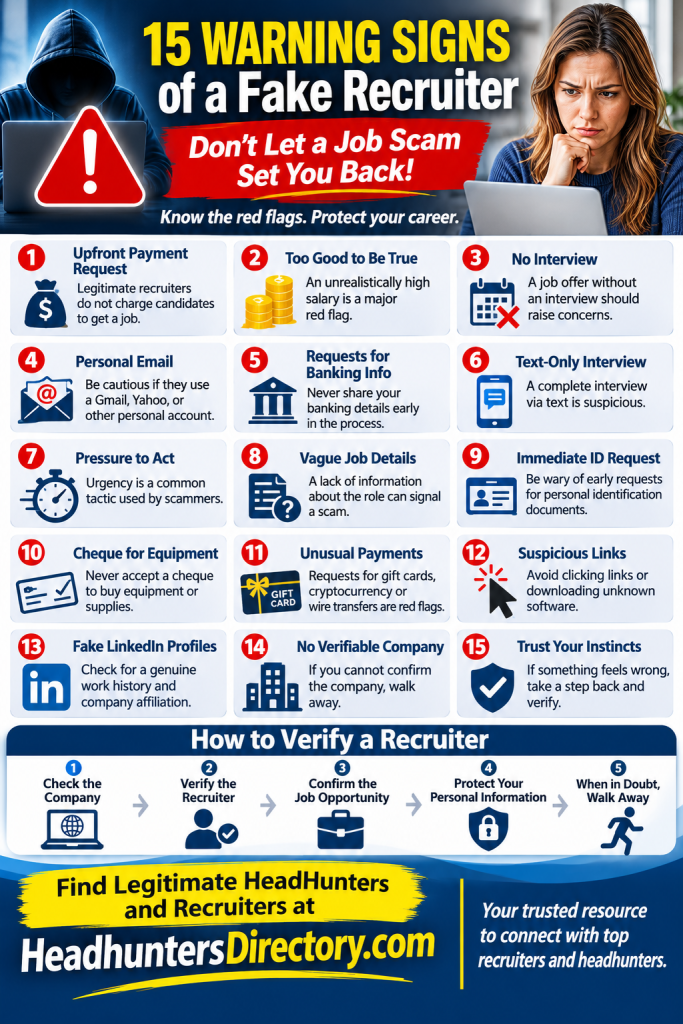
Why Fake Recruiters Are Becoming More Convincing
Recruitment fraud is not new, but technology has made it considerably easier for criminals to impersonate legitimate businesses and recruitment professionals.
Artificial intelligence allows scammers to create convincing job advertisements, professional looking emails, realistic company websites, and personalized messages that appear to have been written specifically for you.
Some fraudulent recruiters even copy the names, photographs, employment histories, and professional credentials of real recruitment consultants.
A message may appear to come from someone who genuinely works for an established executive search firm, staffing agency, or employment recruitment company.
In some cases, the real recruiter has no idea their identity is being used.
This creates a serious challenge for job seekers. Simply recognizing a familiar company name or seeing an impressive LinkedIn profile is no longer enough to establish that someone is legitimate.
You need to verify the person, the recruitment firm, and the opportunity itself.
15 Warning Signs of Fake Recruiters and Employment Scams
1. The Recruiter Asks You to Pay Money to Get a Job
This is one of the biggest warning signs.
Legitimate recruitment agencies generally receive their compensation from the employers who hire their candidates. They do not charge candidates an upfront placement fee simply to introduce them to an employer.
Be extremely cautious if someone claiming to be a recruiter asks you to pay for:
• Job placement services that are supposedly required to secure an interview.
• Registration or application fees.
• Guaranteed employment opportunities.
• Administrative processing fees.
• Access to exclusive job vacancies.
• Mandatory payments to release an employment offer.
There are legitimate career coaching and resume preparation businesses that charge for their services. However, these are different from traditional recruitment agencies representing employers.
Never assume a payment request is legitimate simply because someone claims to represent a recruitment company.
2. You Receive an Unexpected Job Offer Without an Interview
Imagine receiving an email congratulating you on being selected for a senior management position with an excellent salary and benefits.
There is only one problem.
You never applied for the job, never spoke with the employer, and never participated in an interview.
This should immediately raise concerns.
Legitimate employers generally need to evaluate candidates before making hiring decisions. Even when a recruiter approaches someone directly, there will normally be conversations about experience, qualifications, compensation expectations, and suitability.
An unsolicited offer that guarantees employment without any meaningful evaluation is a major warning sign.
Do not provide personal documents or accept employment terms until you independently verify the opportunity.
3. The Recruiter Uses a Personal Email Address
Professional recruitment firms generally communicate through company email addresses.
For example, a legitimate recruiter might use an address associated with the recruitment firm’s official website.
Be cautious if someone claiming to represent a major corporation or established executive search firm contacts you using a Gmail, Outlook, Yahoo, or other personal email account.
There can be legitimate exceptions, particularly among independent recruiters and small businesses, so a personal email address alone does not prove fraud.
However, it should prompt additional verification.
Look up the recruitment firm independently and contact it using the telephone number or email address published on its official website.
Do not rely exclusively on contact information supplied by the person who approached you.
4. The Salary Sounds Too Good to Be True
An unusually attractive salary can be used to convince job seekers to overlook other warning signs.
A fraudulent recruiter might advertise an administrative position paying an executive salary, promise unusually high compensation for minimal experience, or offer substantial earnings for a position with very few responsibilities.
Before becoming excited about an opportunity, research the typical compensation for comparable positions.
Consider:
• The level of responsibility.
• Required qualifications and experience.
• Industry compensation standards.
• Geographic location.
• Whether the salary is consistent with similar positions.
A legitimate employer may certainly offer exceptional compensation for exceptional talent. The concern is when the promised earnings are completely disconnected from the actual job requirements.
5. You Are Asked for Banking Information Too Early
Never provide banking information simply because someone claiming to be a recruiter requests it.
Your banking information should not be necessary during an initial recruitment conversation or preliminary interview.
Fraudsters sometimes claim they need your banking details to arrange payroll, purchase equipment, issue a signing bonus, or process employment documents.
These explanations can be used to obtain information that allows criminals to access financial accounts or conduct fraudulent transactions.
Legitimate payroll arrangements occur through verified employer processes after an employment relationship has been established.
Do not provide banking credentials, passwords, security codes, or account access information to someone you have not independently verified.
6. The Interview Takes Place Entirely Through Text Messages
Modern recruitment involves video interviews, telephone conversations, online meetings, and sometimes written assessments.
However, be cautious when a recruiter claims to be conducting a complete interview through text messages, particularly through WhatsApp, Telegram, or an unfamiliar messaging platform.
A fraudulent recruiter may ask a few basic questions, congratulate you on passing the interview, and immediately proceed to request personal information or money.
Some legitimate employers do use messaging platforms for initial communication, but a complete hiring process involving no meaningful conversation or identity verification deserves scrutiny.
Ask for a proper conversation with the recruiter and independently verify the employer.
7. The Recruiter Pressures You to Act Immediately
Fraudsters often create artificial urgency.
You might be told that:
• The position is available for only a few hours.
• You must pay a fee immediately to secure the opportunity.
• Your employment offer will expire unless you provide documents immediately.
• Several other candidates are waiting to accept the same position.
• You must complete a financial transaction before the employer can proceed.
Legitimate recruitment processes can involve tight deadlines, especially when employers need to fill important vacancies quickly.
However, legitimate recruiters should not require you to bypass basic verification or make questionable payments under pressure.
Take the time necessary to establish whether the opportunity is genuine.
8. The Recruiter Cannot Provide Verifiable Employer Information
A legitimate recruiter should generally be able to explain the nature of the opportunity, the employer’s industry, the position’s responsibilities, and the qualifications being sought.
There are situations where an employer’s identity must remain confidential during an executive search or sensitive recruitment assignment.
That is not automatically suspicious.
However, confidentiality should not prevent a recruiter from explaining the role and providing enough information for you to evaluate whether the opportunity is credible.
Be cautious if the person refuses to discuss basic job responsibilities, compensation arrangements, reporting relationships, or the recruitment process.
A legitimate opportunity should have a meaningful professional explanation.
9. The Recruiter Requests Copies of Your Identification Documents Immediately
There are legitimate reasons employers eventually need to verify a candidate’s identity and eligibility to work.
However, requests for passports, driver’s licences, government identification numbers, or other sensitive documents should occur through appropriate and verified processes.
Be particularly cautious if someone requests these documents before you have even spoken with the employer.
Identity documents can be used in fraudulent financial applications, account openings, impersonation, and other criminal activities.
Ask why the information is required, who will receive it, how it will be protected, and whether it can be provided through a secure employer system at the appropriate stage.
10. The Recruiter Sends You a Cheque to Purchase Equipment
This is a particularly dangerous employment scam.
You may receive an employment offer and be told that the company will send you money to purchase a computer, software, office equipment, or other supplies.
The recruiter then instructs you to deposit a cheque and transfer part of the money to a designated supplier.
The cheque may initially appear to clear, but it can later be identified as fraudulent.
When that happens, you may be responsible for the money you transferred.
Never deposit a cheque and send money to another party simply because someone claiming to be an employer instructs you to do so.
Verify equipment arrangements directly with the actual employer.
11. The Job Description Is Vague or Unusually Generic
Legitimate job advertisements normally explain the responsibilities, qualifications, experience requirements, and expectations associated with the position.
Fraudulent advertisements sometimes contain very little meaningful information.
You might see descriptions such as:
• Work from home and earn substantial income.
• No experience required.
• Flexible hours with unlimited earnings.
• Immediate employment available.
• Guaranteed high income.
These descriptions are not automatically fraudulent, but they become concerning when combined with unrealistic compensation, unclear employer information, and requests for personal information.
A genuine opportunity should provide enough information for you to understand what the position actually involves.
12. The Recruiter Has an Unusual LinkedIn Profile
LinkedIn is an important professional networking and recruitment platform, but having a LinkedIn profile does not establish someone’s identity.
Fraudsters can create fake accounts or impersonate legitimate recruitment professionals.
Look for warning signs such as:
• A recently created profile with little professional history.
• Very few genuine professional connections.
• Inconsistent employment information.
• An unusual employment history.
• A profile photograph that appears elsewhere under another person’s name.
• A company affiliation that cannot be independently verified.
If someone claims to work for an established recruitment firm, visit the firm’s official website and check whether the person is actually employed there.
You can also contact the firm directly to verify the individual’s identity.
13. You Are Asked to Purchase Gift Cards, Cryptocurrency, or Other Unusual Payments
No legitimate recruitment process should require you to purchase gift cards, send cryptocurrency, or transfer money to an unknown person to secure an ordinary employment opportunity.
These payment methods can be difficult to reverse and may be used to move stolen money.
Be particularly suspicious if someone requests payment through:
• Bitcoin or other cryptocurrency.
• Prepaid gift cards.
• Money transfer services.
• Unfamiliar payment applications.
• Transfers to personal accounts.
Never send money to someone claiming that a payment is required to release an employment offer or secure a position.
14. The Recruiter Wants You to Install Unfamiliar Software
Some employment scams involve convincing candidates to download software or open attachments.
A fraudulent recruiter might claim that you need special software to complete an interview, review a job description, or access company documents.
The download could contain malware designed to steal passwords, monitor your computer, or obtain sensitive information.
Only install recruitment or interview software from verified official sources.
Be especially cautious if someone asks you to disable security settings, share your screen while accessing financial accounts, or provide remote access to your computer.
A legitimate interview should never require you to surrender control of your personal devices.
15. You Cannot Independently Verify the Recruitment Company
This is perhaps the most important test.
Before trusting a recruiter, investigate the company they claim to represent.
Look for:
• An established company website.
• A verifiable business address.
• Published business telephone numbers.
• A consistent professional history.
• Genuine employees and recruitment consultants.
• A recognizable industry presence.
• Evidence that the company actually provides recruitment services.
Do not simply trust a website because it looks professional.
Fraudsters can create convincing websites using copied company descriptions, photographs, logos, and contact information.
If you cannot independently establish that the recruitment company exists and that the person contacting you genuinely works there, do not proceed with sharing sensitive information.

Verify That a Recruiter Is Legitimate
How to Verify That a Recruiter Is Legitimate Before Responding
Recognizing warning signs is important, but having a consistent verification process is even better.
Before engaging with an unfamiliar recruiter, take these steps.
Step 1: Identify the Recruitment Firm
Ask the recruiter which company they represent.
Visit the company’s official website independently rather than clicking links supplied in an unsolicited message.
Review its recruitment specialties, business history, office locations, and professional contact information.
Step 2: Verify the Individual Recruiter
Look for the recruiter on the company’s official website or professional networking profiles.
If you cannot establish their identity, contact the recruitment firm directly and ask whether the person works there.
Step 3: Verify the Job Opportunity
Ask for details about the position, responsibilities, required experience, compensation range, and expected hiring process.
If the employer is confidential, the recruiter should still be able to provide meaningful information about the assignment.
Step 4: Never Pay to Secure a Traditional Recruitment Placement
Understand the difference between recruitment agencies representing employers and businesses selling career coaching or job search assistance.
Traditional recruitment firms generally earn their fees from employers when they successfully place candidates.
Be particularly cautious of anyone promising guaranteed employment in exchange for an upfront payment.
Step 5: Protect Your Personal Information
Do not provide sensitive identification, financial details, passwords, or security codes during an unverified recruitment conversation.
Only provide necessary documentation through appropriate, verified employer channels when the hiring process reaches the relevant stage.
Step 6: Trust Your Instincts
If something does not feel right, stop communicating until you have independently verified the situation.
You do not owe an unfamiliar recruiter your personal information simply because they claim to have an exciting job opportunity.

Targeted by a Fake Recruiter?
Do This!
What Should You Do If You Have Been Targeted by a Fake Recruiter?
If you suspect someone is attempting to defraud you, take action immediately.
If you have only received a suspicious message:
- Do not click suspicious links or download attachments.
- Do not provide personal or financial information.
- Do not send money.
- Verify the recruitment firm independently.
- Report the suspicious account to the relevant platform.
If you have already provided personal information:
- Contact your financial institutions if banking information was disclosed.
- Change passwords that may have been compromised.
- Enable multifactor authentication on important accounts.
- Contact the relevant government identity protection or credit reporting services.
- Report suspected identity theft to the appropriate authorities.
If you have sent money:
Contact your bank or payment provider immediately. Explain that you may have been the victim of employment fraud and ask whether the transaction can be stopped or reversed.
Report the incident to the appropriate authorities in your country.
In the United States, the Federal Trade Commission accepts reports of employment scams. In Canada, report suspected fraud to the Canadian Anti Fraud Centre. In the United Kingdom, report fraud through Action Fraud. In Australia, report scams through Scamwatch.
Acting quickly can make an important difference.
How to Find Legitimate Headhunters and Recruitment Agencies
One of the best ways to reduce the risk of dealing with fraudulent recruiters is to be proactive about identifying recruitment firms rather than relying exclusively on unsolicited messages.
Instead of waiting for an unknown person to approach you through social media or email, take the initiative to identify recruitment professionals who specialize in your industry, location, and career level.
This allows you to research the company, understand its recruitment focus, and initiate contact through independently verified channels.
A specialized recruiter may be able to introduce you to employers seeking professionals with your particular experience and qualifications.
Recruitment firms operate across virtually every major employment sector, including:
• Accounting and finance.
• Engineering and manufacturing.
• Information technology.
• Healthcare and medical professions.
• Construction and skilled trades.
• Sales and business development.
• Marketing and communications.
• Human resources.
• Transportation and logistics.
• Executive and senior management.
The important thing is to find recruiters who understand your professional background and the types of opportunities you want to pursue.
This is where HeadhuntersDirectory.com can help.
The directory covers recruitment firms across the United States, Canada, the United Kingdom, and Australia.
You can search by geographic location and explore recruitment firms that specialize in different industries and professional disciplines.
Rather than relying entirely on unsolicited recruitment messages, you can take a more proactive approach to identifying legitimate recruitment businesses and building professional relationships.
Whether you are looking for your first professional opportunity, pursuing a management position, considering a career change, or exploring senior executive opportunities, connecting with the right recruitment professionals can expand your options.
Frequently Asked Questions About Fake Recruiters and Job Scams
Do legitimate recruiters ever charge job seekers money?
Traditional recruitment agencies working on behalf of employers generally receive their compensation from the hiring company, not the candidate. Be cautious of anyone requesting an upfront payment to secure a traditional job placement. Separate career coaching and resume preparation services may legitimately charge fees for their services.
How can I tell if a recruiter contacting me on LinkedIn is legitimate?
Check the recruiter’s employment history, professional connections, company affiliation, and contact information. Visit the recruitment firm’s official website and independently contact the company to verify that the individual works there.
Can a recruiter ask for my Social Insurance Number or Social Security Number?
An employer may eventually need this information for legally required employment, tax, or payroll processes. However, an unfamiliar recruiter should not need your sensitive identification information during an initial conversation. Verify the employer and use an appropriate secure process before providing it.
Are WhatsApp recruitment messages legitimate?
Some legitimate recruiters use messaging applications to communicate with candidates. However, unsolicited messages that offer immediate employment, promise unusually high salaries, request payments, or demand personal information should be treated cautiously.
Can a fake recruiter steal my identity?
Yes. Fraudsters may request identification documents, banking information, addresses, dates of birth, and other personal details to impersonate individuals or commit financial fraud.
Why do scammers pretend to work for legitimate recruitment agencies?
Established recruitment companies have credibility and professional reputations. By impersonating their employees, scammers hope to gain the trust of job seekers who might otherwise recognize suspicious activity.
What should I do if a recruiter asks me to pay an employment fee?
Do not pay until you have independently established exactly what service is being offered and whether the arrangement is legitimate. Traditional recruitment agencies generally receive placement fees from employers rather than charging candidates to obtain employment.
Are executive recruiters and headhunters legitimate?
Yes. Professional executive recruiters and headhunters work with employers to identify, evaluate, and introduce qualified candidates for specific positions. Many specialize in senior management, executive leadership, technical professions, and other specialized occupations. As with any service, verify the individual and recruitment firm before sharing sensitive information.
Where can I find legitimate headhunters and recruitment agencies?
You can use HeadhuntersDirectory.com to explore recruitment agencies, executive search firms, staffing agencies, and specialized recruiters across the United States, Canada, the United Kingdom, and Australia. The directory is free to use and allows job seekers to identify recruitment professionals by location and specialty.
Protect Your Career While Opening the Door to Better Opportunities
Your career is one of your most valuable assets. Finding the right opportunity can improve your financial future, provide greater professional satisfaction, and open doors you may never have considered.
Do not allow the fear of employment scams to prevent you from exploring new opportunities. Legitimate recruiters play an important role in helping employers find exceptional talent and helping professionals advance their careers.
The key is knowing who you are dealing with.
Verify the recruiter. Research the company. Understand the opportunity. Protect your personal information. Never allow artificial urgency or promises of guaranteed employment to override common sense.
Most importantly, take control of your career search.
Instead of relying entirely on unsolicited messages, identify professional recruitment firms that specialize in your industry and location.
HeadhuntersDirectory.com makes that process easier by providing a free resource for connecting with headhunters, recruiters, employment agencies, and executive search firms.
Your next great career opportunity could be just one professional introduction away. Make sure it comes from the right person.
Your Next Career Starts With the Right Connections
The most successful careers are rarely built through online job applications alone.
Behind many remarkable executive careers are trusted relationships with experienced headhunters and executive recruiters who recognized talent before everyone else.
If you want access to opportunities that never appear on traditional job boards, now is the time to become visible, strengthen your professional brand, and connect with respected executive recruiters.
Top Interview Questions and Best Answers!
How to Answer “Tell Me About a Challenge or Conflict?”
How to Answer “Can You Tell Me About a Time You Disagreed With Your Manager?”
How to Best Answer “Why Did You Leave Your Last Job?”
How to Answer “Do You Have Any Questions for Us?”
How to Answer “Tell Me About Yourself”
How to Answer “What motivates you?”
How to Answer “How do you handle feedback or criticism?”
20 Secret Signs You Aced the Interview!
How to Answer “How Would Your Previous Employer Describe You?
How to Answer “What makes you unique?”
How to Answer “How Do You Handle Stress or Pressure?”
How to Answer “How do you stay organized?”
How to Answer “Why do you want to work for us?”
How to Answer “What do you know about our company?”
How to Answer “What are your career goals”
How to Answer “Can You Describe a time you helped resolve a conflict?”
How to Answer “Are you willing to relocate?”
How to Answer “What Are Your Long Term Goals?”
How to Answer “Tell me about a time you took initiative”
How to Answer “Are you willing to travel for work?”
How to Answer “How do you prioritize your work?”
How to Answer “How do you manage competing priorities?”
How to Answer “Tell me about a time you taught or mentored someone.”
How to Answer “What Accomplishments Are You Most Proud Of?”
How to Answer “Describe How You Handled a High Pressure Situation”
How to Answer “What Are Your Hobbies or Interests?” in a Job Interview
How to Answer “What would you look to accomplish in your first 90 days?”
How to Answer “What did you like least about your last job?”
How to Answer “What are your passions?” In Job Interview
How to Answer “Describe a time you worked as part of a team.”
How to Answer “What did you like most about your last job?”
How to Answer “How Would You Adapt to Change at Work?” in a Job Interview
How to Answer “How do you stay current with industry trends?” in a Job Interview
How to Answer “What leadership style works best for you?” in a Job Interview
How to Answer “Describe a Time You Failed and What You Learned” in a Job Interview
How to Answer “What Challenges Are You Looking For?” in a Job Interview
How to Answer “What was the last goal you set and how did you achieve it?” in a Job Interview
How to Answer “Tell me about a time you disagreed with a colleague.” in a Job Interview
Here are some great additional article that you will find very helpful as you polish that resume:
Cover Letter Mistakes to Avoid
Best Transferable Skills for Resumes
The 6-Second Resume Test: How Recruiters Screen Candidates
Resume Action Words & Power Verbs: Tips & Examples
What Not To Put on a Resume Tips to Ensure Your Resume Works
Get Noticed by Executive Search Firms: A Step by Step Guide
10 Most Sought After Soft Skills Employers Love
The Worst Things to Put on a Resume (and What to Do Instead)
Why Your Resume Isn’t Getting Noticed and How Recruiters Can Change That
How Long Should a Resume Be? Tips for Today’s Candidates
10 Very Common Resume Mistakes and How To Avoid Them
Do Headhunters and Recruiters Prefer Shorter Resumes?
More Great Articles For You!
- How Long Should a Resume Be? Tips for Today’s Candidates
- Job Interview Secrets
- How to Dress For Your Interview
- How to Stay Positive and Motivated During Your Job Search
- How To Succeed in Todays Job Market
- Top Job Search Sites in USA
- Top Job Search Sites in Canada
- Top Job Search Sites in UK
- Top Job Search Sites in Australia
- Best-Paying Jobs That Don’t Require a Degree!
- Top 25 Highest-Paying Jobs You Can Land Through a Headhunter
- 100 Jobs That Pay $100K or More: A Guide for Ambitious Job Seekers
- Jobs That Pay 200K or More
- Jobs That Pay $500K or More
- Most Endangered Jobs Because of AI
- Benefits of Using Local Headhunters and Recruiters
Visit HeadhuntersDirectory.com today to connect with trusted recruiters, headhunters, and executive search firms across the USA, Canada, the UK, and Australia. Find your match, grow your network, and discover opportunities you didn’t even know existed.

- How to Spot Fake Recruiters and Job Scams: 15 Warning Signs

- Ghost Jobs: Why Companies Advertise Jobs They Aren’t Filling

- How Executive Recruiters Unlock Jobs You Will Never Find Online

- 10 Signs It’s Time to Leave Your Job Even If the Money Is Great

- How Recruiters Actually Read Your Resume in 30 Seconds

- 10 Reasons Why Recruiters Never Call Qualified Candidates

- 12 Things You Should Never, Ever Say to Your Boss

- Why Networking Still Beats Applying Online

- What Recruiters Wish Every Candidate Knew 15 Insider Tips for Job Seekers