Ghost Jobs: Why Companies Advertise Jobs They Aren’t Actually Hiring For and How to Avoid Wasting Your Time
What are ghost jobs? Ghost jobs are job advertisements for positions that employers do not currently intend to fill. They may be posted to collect resumes, assess available talent, prepare for future hiring or remain online after a vacancy has been cancelled or filled.

How To Identify Ghost Jobs
You find a promising job advertisement. The salary looks attractive, the responsibilities match your experience, and the company seems like an excellent place to work. You update your resume, write a cover letter, complete the application and wait.
Days pass. Then weeks. You hear nothing.
You check the advertisement again. The position is still there. You apply again through another job website. Perhaps you even receive an automated email confirming that your application has been received. But nobody contacts you, nobody schedules an interview and the job continues appearing online.
What if the company was never planning to hire anyone in the first place?
This is the frustrating reality behind a growing employment issue known as ghost jobs. These are job advertisements for positions that do not currently exist or that employers are not actively planning to fill. Some are deliberately posted to collect resumes or assess the availability of talent. Others remain online because a hiring decision has been delayed, a position has been filled or the employer has changed its plans.
For job seekers, the result can be the same: wasted time, unnecessary frustration and the feeling that finding a new job has become almost impossible.
The problem deserves attention. Surveys show that 39.3 percent of job seekers identified fake, fraudulent or ghost job postings as one of their major job search challenges. Another 42.8 percent said they were frustrated by how difficult it can be to determine whether a job or employer advertised online is legitimate.
The important question is not simply how many ghost jobs exist. It is how you can recognize questionable opportunities, avoid wasting time on them and find employers who are genuinely looking for someone with your qualifications.
Here is what every job seeker should understand.
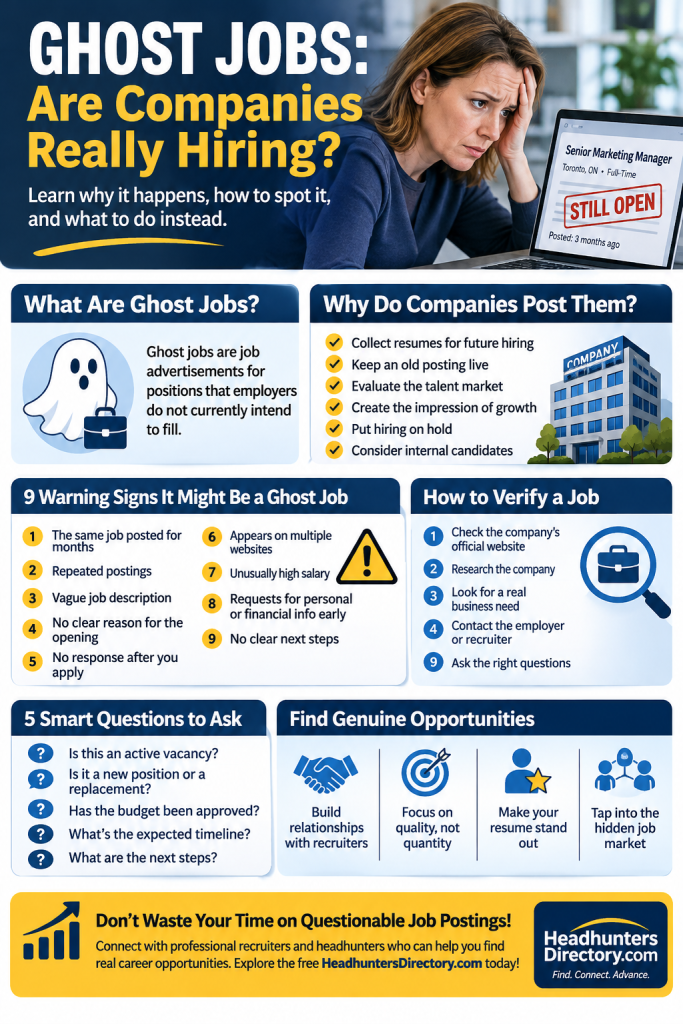
What Exactly Is a Ghost Job?
A ghost job is an advertised employment opportunity for a position that an employer does not currently intend to fill.
Unlike a conventional job advertisement, which represents an active effort to recruit and hire someone, a ghost job may have been published for another reason. The company might want to collect resumes for future hiring, evaluate the available talent in the market or create the appearance that its workforce is expanding.
Some advertisements are not deliberately misleading. A company may have initially planned to hire someone but later cancelled the position, lost its hiring budget or decided to promote an existing employee. The original advertisement may remain online even though the vacancy is no longer available.
It is also important to distinguish ghost jobs from employment scams. A ghost job can be advertised by a real company with a legitimate website and an established business. A fraudulent job advertisement may involve an entirely fake company, an impersonated recruiter or someone attempting to steal personal information or money.
Both situations can waste a job seeker’s time, but they are not the same problem.
The United States Congressional Research Service has examined ghost job postings and identified several reasons employers may advertise positions they are not immediately planning to fill. These include building a pool of potential candidates, signalling anticipated growth and evaluating the available talent market.
In other words, not every job advertisement represents an actual hiring opportunity.
Why Do Companies Advertise Jobs They Are Not Hiring For?
Understanding why ghost jobs exist makes it easier to recognize them. There are several reasons employers may continue advertising positions without actively recruiting someone to fill them.
1. They Want to Collect Resumes for Future Hiring
Some companies want to build a database of qualified candidates before they actually need additional employees.
For example, a manufacturing company may anticipate expanding production within six months. Rather than waiting until the expansion is approved, it may advertise positions for engineers, supervisors, production managers and technicians.
The company receives applications and builds a list of potential candidates. However, it has no immediate intention of hiring anyone.
From the employer’s perspective, this may be a convenient way to prepare for future recruitment. From the job seeker’s perspective, it can mean applying for a position that is not currently available.
2. The Company Has Already Filled the Position
A company may advertise a position, interview several candidates and ultimately hire someone.
Unfortunately, the original advertisement may remain active.
Some employers fail to remove old postings from their own websites. Others advertise through multiple recruitment platforms and may not realize that the position is still appearing elsewhere.
This is particularly common when job advertisements are copied or automatically distributed across multiple websites.
A position that has already been filled is not necessarily evidence of deliberate deception. Nevertheless, it creates a frustrating experience for anyone who continues applying.
3. The Employer Wants to Evaluate the Talent Market
Companies sometimes advertise positions to determine whether suitable candidates are available.
For example, an employer may be considering hiring a senior financial controller but may not know what salary would attract someone with the required experience.
By advertising the position, the company can evaluate the number of applicants, their qualifications, salary expectations and availability.
The company may then use this information to make future hiring decisions.
The problem is that applicants may believe they are competing for an actual vacancy when the employer is simply conducting market research.
4. The Company Wants to Appear to Be Growing
Job advertisements can create the impression that a company is expanding.
An employer may want customers, investors, competitors or existing employees to believe that the business is growing and preparing to hire additional people.
Advertising several positions can create that impression even when the company has no immediate hiring plans.
This is one of the more concerning reasons ghost jobs exist because the advertisement may serve a purpose unrelated to recruiting.
5. The Employer Has Put Hiring on Hold
Sometimes a position is genuinely available when it is first advertised.
However, circumstances change.
The company may experience a decline in revenue, lose a major customer, change its budget or decide to postpone an expansion. Management may temporarily freeze hiring without removing existing advertisements.
The result is a job posting that appears active but is no longer connected to an immediate hiring decision.
6. The Company Plans to Hire Internally
An employer may advertise a position even though management already has an internal candidate in mind.
The company may want to compare external candidates, satisfy an internal recruitment process or demonstrate that it considered other applicants.
An external applicant may invest considerable time in the process without having a realistic chance of receiving an offer.

9 Warning Signs The Job is Fake!
9 Warning Signs That a Job Posting Might Be a Ghost Job
There is no single way to determine with absolute certainty whether a job advertisement is genuine. However, several warning signs can help you decide whether an opportunity deserves your time.
One warning sign does not automatically mean a job is fake. Look for several indicators together.
1. The Same Job Has Been Advertised for Months
A position that remains advertised for an unusually long time deserves closer attention.
Some jobs genuinely take longer to fill. Specialized engineering, healthcare, executive and senior management positions can require extensive recruitment processes.
However, if an ordinary position has appeared repeatedly for several months without any indication of progress, it is reasonable to question whether the company is actively hiring.
Check the original posting date rather than relying only on the date displayed by a job website. Some platforms refresh advertisements automatically.
2. The Company Continually Reposts the Same Position
Have you noticed the same company advertising an identical position every few weeks?
Repeated postings can indicate that the employer is having difficulty finding suitable candidates. However, they can also indicate that the company is collecting resumes without an immediate intention to hire.
Look for identical job descriptions, salary information, responsibilities and qualifications.
If the advertisement repeatedly disappears and returns without any meaningful changes, consider contacting the company before investing time in an application.
3. The Job Description Is Extremely Vague
Genuine employers generally have a clear understanding of the responsibilities and qualifications required for a position.
Be cautious when a job advertisement contains very little information about the actual work.
Warning signs include:
- No specific responsibilities or measurable expectations.
- No clear reporting structure.
- No information about the department or team.
- No meaningful explanation of why the position is available.
- Broad qualifications that could apply to almost anyone.
A vague advertisement may be designed to attract as many resumes as possible rather than recruit someone for a specific vacancy.
4. The Company Cannot Explain Why the Position Is Available
One of the most useful questions you can ask is whether the position represents a new role or a replacement for someone who has left.
A genuine hiring manager or recruiter should generally be able to provide some explanation.
For example, the company may be expanding, replacing a retiring employee, adding capacity to a department or responding to increased customer demand.
If nobody can explain why the position exists or what business need it addresses, you may want to investigate further.
5. Nobody Responds After You Apply
Not receiving a response does not automatically mean a job is a ghost job.
Employers receive large numbers of applications, recruitment teams can be understaffed and hiring processes can take longer than expected.
However, if a company continually advertises the same position, acknowledges applications but never contacts candidates, and provides no information about the recruitment process, it may be worth questioning whether the vacancy is genuine.
6. The Advertisement Appears on Multiple Websites With Different Details
Look carefully at the company name, job title, salary, location and application instructions.
Sometimes third party job websites copy advertisements from other sources. The original posting may have been removed while copies remain active.
Other times, questionable advertisements contain inconsistent company information or direct applicants to unfamiliar websites.
Whenever possible, locate the opportunity on the employer’s official careers page and apply through a verified channel.
7. The Salary Is Unusually Attractive
An exceptionally high salary combined with minimal qualifications and vague responsibilities deserves scrutiny.
Some legitimate positions offer excellent compensation, particularly in specialized industries. However, unrealistic salaries are also commonly used to attract attention to fraudulent advertisements.
Be especially cautious if the employer promises unusually high earnings without explaining the responsibilities, qualifications or compensation structure.
8. The Employer Wants Personal or Financial Information Too Early
Never provide sensitive financial information, banking details or identity documents to an unverified recruiter.
A legitimate employer may eventually need information for payroll, background checks or employment verification. However, these requests should occur at an appropriate stage through a trustworthy process.
Be suspicious of anyone who asks you to pay for training, equipment, background checks or administrative fees as a condition of being considered for a job.
9. Nobody Can Tell You What Happens Next
A genuine recruitment process should have some identifiable next steps.
You should be able to establish who is responsible for recruitment, whether applications are being reviewed and approximately when interviews or hiring decisions may take place.
If the employer or recruiter cannot provide even a basic explanation of the process, consider whether the opportunity deserves further attention.

The Genuine Vacancy Checklist
How to Determine Whether a Company Is Actually Hiring
Before spending hours preparing an application, take a few minutes to verify the opportunity.
These steps can help you distinguish a genuine vacancy from a questionable advertisement.
Step 1: Find the Job on the Company’s Official Website
Do not rely exclusively on third party job websites.
Visit the employer’s official website and look for its careers or employment section.
If the position is not listed there, contact the company directly to confirm whether it is still accepting applications.
Keep in mind that some employers recruit through external agencies and may not publish every vacancy on their own website. The absence of an advertisement on the company website is therefore not proof that a job is fake.
Step 2: Research the Company
Look at the company’s website, business operations, recent announcements and professional presence.
Does the company appear to be operating normally? Does it have an established management team? Is there evidence of expansion, new contracts, additional locations or other developments that might explain the hiring need?
A company that has recently announced a major expansion may have legitimate reasons to recruit additional employees.
Step 3: Check the Original Posting Date
Determine when the job was first advertised.
A posting that has been online for a long time may be legitimate, particularly for difficult to fill positions. However, an old posting should prompt you to ask whether the vacancy remains active.
Do not assume that a recently refreshed advertisement represents a newly approved vacancy.
Step 4: Contact the Employer or Recruiter
A short, professional inquiry can save you considerable time.
Ask whether the position is currently approved and whether the employer is actively interviewing candidates.
If the company is using a recruitment firm, ask whether the recruiter is working on an active search.
A professional recruiter should be able to explain the position, the employer’s requirements and the recruitment process without making unrealistic promises.
Step 5: Look for Evidence of a Real Business Need
Consider the nature of the position.
Is the company opening a new location? Has it announced a major contract? Is it expanding production? Has a senior employee retired? Is there a clear reason the organization would need someone with these qualifications?
The more clearly the position connects to an identifiable business requirement, the more confidence you may have that the opportunity is genuine.
5 Questions You Should Ask Before Applying
You do not need to interrogate an employer or recruiter before submitting your resume. However, asking a few straightforward questions can help you understand whether an opportunity is worth pursuing.
Consider asking:
1. Is this an active vacancy that the company intends to fill now?
This is the most important question. It helps distinguish an immediate hiring requirement from an advertisement intended to collect resumes for future consideration.
2. Is this a newly created position or a replacement for an existing employee?
The answer can help you understand why the employer is hiring and what the company needs.
3. Has the hiring manager approved the position and its budget?
A position that has not received final approval may be delayed or cancelled.
4. What is the expected hiring timeline?
Ask when the employer expects to conduct interviews and make a decision.
5. What are the next steps after I submit my application?
A clear answer gives you a better understanding of how the recruitment process works.
These questions are entirely reasonable. A serious employer should understand that qualified candidates also want to make informed decisions about where they invest their time.
Why Recruiters Sometimes Know About Jobs That Never Appear Online
One of the biggest mistakes job seekers make is assuming that every genuine employment opportunity is advertised publicly.
Many employers use recruitment agencies and executive search firms to identify qualified candidates. In some cases, a company may prefer to conduct a confidential search rather than publicly advertise the position.
For example, an organization may be looking to replace a senior executive without announcing the departure of the existing employee. A manufacturer may need an experienced engineering manager but want a recruiter to identify candidates discreetly. A growing business may need a sales director but prefer to approach proven professionals directly.
These opportunities may never appear on conventional job boards.
Professional recruiters can also have direct relationships with hiring managers and employers. They may know which companies are expanding, which departments are recruiting and which organizations are preparing to hire.
This does not mean every recruiter has access to every hidden opportunity. It does mean that developing relationships with recruiters who specialize in your industry can give you another route into the employment market.
Rather than relying entirely on online applications, consider learning how to work with headhunters and recruiters and building relationships with recruitment professionals who understand your experience and career objectives.
How to Find Genuine Job Opportunities Before Everyone Else
If you want to improve your chances of finding a new position, you need to think beyond simply applying to every advertisement you see.
The objective should be to identify genuine employers with real hiring requirements and make it easier for them to recognize the value you can bring.
1. Build Relationships With Recruiters Who Specialize in Your Industry
Recruiters often specialize in particular industries, professions, geographic markets or management levels.
For example, a recruiter specializing in manufacturing may work with companies hiring production managers, mechanical engineers, plant managers, quality professionals and operations executives.
A recruiter specializing in finance may work with organizations looking for controllers, accountants, financial analysts and senior finance leaders.
The more closely a recruiter’s specialization matches your background, the more relevant the relationship may be.
You can begin by identifying recruitment firms that regularly work with employers in your industry and geographic area.
HeadhuntersDirectory.com headhunter and recruiter directory provides a way to explore recruitment firms and executive search professionals across different locations and industries.
2. Make Your Resume Easy for Recruiters to Understand
Recruiters frequently review large numbers of resumes. Your experience, qualifications and professional achievements need to be immediately understandable.
Do not simply list previous job responsibilities. Explain what you accomplished.
For example, instead of writing that you were responsible for sales management, explain that you managed a sales team, developed new customer relationships and increased annual revenue.
Use relevant industry terminology, clearly identify your areas of expertise and make your career progression easy to follow.
For more guidance, read How Recruiters Actually Read Your Resume in 30 Seconds.
3. Stop Relying on Application Volume Alone
Submitting hundreds of applications may create the impression that you are making progress. However, the number of applications you submit is not necessarily a good measure of the quality of your job search.
A more effective strategy is to identify a smaller number of relevant employers, understand their hiring requirements and make direct connections with people involved in recruitment.
Targeted applications, professional networking and recruiter relationships can help you spend more time pursuing opportunities that genuinely match your experience.
You may also want to read Why Applying to Hundreds of Jobs Rarely Works.
4. Contact Companies That Have a Reason to Hire Someone Like You
Do not wait for every employer to publish a job advertisement.
Research companies that are expanding, winning new contracts, opening facilities, entering new markets or experiencing increased demand.
These developments may create a need for additional employees.
If your experience matches the company’s requirements, consider making a professional introduction to the appropriate hiring manager or human resources representative.
An employer may be interested in speaking with a qualified candidate even if it has not yet published a formal job advertisement.
5. Become Known in Your Professional Community
Professional relationships can make a significant difference in a competitive employment market.
Stay connected with former colleagues, managers, suppliers, customers and industry contacts.
Attend relevant industry events and participate in professional discussions. Keep your professional profile current and make it clear what types of opportunities interest you.
When people know your experience and capabilities, they may think of you when a suitable position becomes available.
Why Finding a Job Is About More Than Finding an Advertisement
The traditional approach to finding employment is straightforward.
Search job websites, identify interesting positions, submit applications and wait for employers to respond.
Unfortunately, this approach puts almost all the responsibility on the job seeker. You are competing with potentially hundreds of other applicants, relying on advertisements that may not be current and often have little direct contact with the people making hiring decisions.
A better approach combines several strategies.
Continue monitoring job advertisements, but do not make them your only source of opportunities. Research employers, build professional relationships, contact relevant recruiters and make your experience visible to people who can influence hiring decisions.
Most importantly, focus on the quality of opportunities rather than the quantity of applications.
A single conversation with a recruiter who specializes in your industry may be more valuable than submitting dozens of applications to employers who have no immediate intention of hiring.
Find Recruiters and Headhunters Who Can Help You Access Real Opportunities
The existence of ghost jobs is another reason job seekers should consider expanding their approach to finding employment.
You should not have to spend endless hours applying to advertisements without knowing whether an employer is genuinely hiring.
Professional recruiters and headhunters work with employers to identify, evaluate and introduce qualified candidates. Depending on their specialization and client relationships, they may be able to connect you with opportunities that are not widely advertised.
The key is finding recruiters who understand your industry, professional background and career objectives.
That is where HeadhuntersDirectory.com can help.
HeadhuntersDirectory.com is a free online resource designed to help job seekers connect with headhunters, recruiters, executive search firms and employment agencies across the United States, Canada, the United Kingdom and Australia.
Instead of relying exclusively on online job advertisements, you can use the directory to identify recruitment professionals who specialize in the type of work you want to pursue.
Whether you are looking for a professional position, a management opportunity, a senior executive role or a new direction in your career, connecting with the right recruitment professionals can open additional doors.
Do not let questionable job advertisements dictate your career search. Take a more proactive approach, build relationships with professional recruiters and put yourself in a stronger position to discover genuine employment opportunities.
Visit HeadhuntersDirectory.com today and explore one of the best free online resources for connecting with headhunters and executive recruiters.
Your next career opportunity may come from a conversation with the right recruiter, not another online application.
Your Nest Career Starts With the Right Connections
The most successful careers are rarely built through online job applications alone.
Behind many remarkable executive careers are trusted relationships with experienced headhunters and executive recruiters who recognized talent before everyone else.
If you want access to opportunities that never appear on traditional job boards, now is the time to become visible, strengthen your professional brand, and connect with respected executive recruiters.
Top Interview Questions and Best Answers!
How to Answer “Tell Me About a Challenge or Conflict?”
How to Answer “Can You Tell Me About a Time You Disagreed With Your Manager?”
How to Best Answer “Why Did You Leave Your Last Job?”
How to Answer “Do You Have Any Questions for Us?”
How to Answer “Tell Me About Yourself”
How to Answer “What motivates you?”
How to Answer “How do you handle feedback or criticism?”
20 Secret Signs You Aced the Interview!
How to Answer “How Would Your Previous Employer Describe You?
How to Answer “What makes you unique?”
How to Answer “How Do You Handle Stress or Pressure?”
How to Answer “How do you stay organized?”
How to Answer “Why do you want to work for us?”
How to Answer “What do you know about our company?”
How to Answer “What are your career goals”
How to Answer “Can You Describe a time you helped resolve a conflict?”
How to Answer “Are you willing to relocate?”
How to Answer “What Are Your Long Term Goals?”
How to Answer “Tell me about a time you took initiative”
How to Answer “Are you willing to travel for work?”
How to Answer “How do you prioritize your work?”
How to Answer “How do you manage competing priorities?”
How to Answer “Tell me about a time you taught or mentored someone.”
How to Answer “What Accomplishments Are You Most Proud Of?”
How to Answer “Describe How You Handled a High Pressure Situation”
How to Answer “What Are Your Hobbies or Interests?” in a Job Interview
How to Answer “What would you look to accomplish in your first 90 days?”
How to Answer “What did you like least about your last job?”
How to Answer “What are your passions?” In Job Interview
How to Answer “Describe a time you worked as part of a team.”
How to Answer “What did you like most about your last job?”
How to Answer “How Would You Adapt to Change at Work?” in a Job Interview
How to Answer “How do you stay current with industry trends?” in a Job Interview
How to Answer “What leadership style works best for you?” in a Job Interview
How to Answer “Describe a Time You Failed and What You Learned” in a Job Interview
How to Answer “What Challenges Are You Looking For?” in a Job Interview
How to Answer “What was the last goal you set and how did you achieve it?” in a Job Interview
How to Answer “Tell me about a time you disagreed with a colleague.” in a Job Interview
Here are some great additional article that you will find very helpful as you polish that resume:
Cover Letter Mistakes to Avoid
Best Transferable Skills for Resumes
The 6-Second Resume Test: How Recruiters Screen Candidates
Resume Action Words & Power Verbs: Tips & Examples
What Not To Put on a Resume Tips to Ensure Your Resume Works
Get Noticed by Executive Search Firms: A Step by Step Guide
10 Most Sought After Soft Skills Employers Love
The Worst Things to Put on a Resume (and What to Do Instead)
Why Your Resume Isn’t Getting Noticed and How Recruiters Can Change That
How Long Should a Resume Be? Tips for Today’s Candidates
10 Very Common Resume Mistakes and How To Avoid Them
Do Headhunters and Recruiters Prefer Shorter Resumes?
More Great Articles For You!
- How Long Should a Resume Be? Tips for Today’s Candidates
- Job Interview Secrets
- How to Dress For Your Interview
- How to Stay Positive and Motivated During Your Job Search
- How To Succeed in Todays Job Market
- Top Job Search Sites in USA
- Top Job Search Sites in Canada
- Top Job Search Sites in UK
- Top Job Search Sites in Australia
- Best-Paying Jobs That Don’t Require a Degree!
- Top 25 Highest-Paying Jobs You Can Land Through a Headhunter
- 100 Jobs That Pay $100K or More: A Guide for Ambitious Job Seekers
- Jobs That Pay 200K or More
- Jobs That Pay $500K or More
- Most Endangered Jobs Because of AI
- Benefits of Using Local Headhunters and Recruiters
Visit HeadhuntersDirectory.com today to connect with trusted recruiters, headhunters, and executive search firms across the USA, Canada, the UK, and Australia. Find your match, grow your network, and discover opportunities you didn’t even know existed.

- Ghost Jobs: Why Companies Advertise Jobs They Aren’t Filling

- How Executive Recruiters Unlock Jobs You Will Never Find Online

- 10 Signs It’s Time to Leave Your Job Even If the Money Is Great

- How Recruiters Actually Read Your Resume in 30 Seconds

- 10 Reasons Why Recruiters Never Call Qualified Candidates

- 12 Things You Should Never, Ever Say to Your Boss

- Why Networking Still Beats Applying Online

- What Recruiters Wish Every Candidate Knew 15 Insider Tips for Job Seekers

- Why Applying to Hundreds of Jobs Rarely Works