How to Change Careers at Any Age
The Complete Guide to Starting a New Career Without Starting Over
Changing careers at any age is possible without starting over. Learn how to identify transferable skills, explore new industries, update your resume, connect with recruiters and create a practical 90 day plan for launching a rewarding new career.

Change Careers at Any Age
Guide to Starting a New Career Without Starting Over
Changing careers can be one of the most rewarding decisions you ever make. Whether you are 25, 40, 50 or approaching retirement, the opportunity to pursue a different profession, discover new interests and build a more fulfilling working life is always worth considering.
Perhaps you have spent years in an industry that no longer excites you. Maybe you have reached the highest position available in your organization, feel underappreciated, or simply want to do something more meaningful. You might be concerned about job security, frustrated by limited advancement opportunities, or wondering whether your existing experience will be valuable somewhere else.
Whatever your circumstances, one thing is important to understand: Changing careers does not mean starting your professional life from scratch.
You have accumulated knowledge, developed professional relationships, solved difficult problems, managed responsibilities and acquired skills that employers in other industries may value enormously. The challenge is learning how to recognize those strengths, communicate them effectively and position yourself for opportunities in a different field.
The modern employment market offers more opportunities for career mobility than many people realize. Employers increasingly recognize that valuable talent does not always come from traditional career paths. Someone with extensive customer service experience might become an excellent sales professional. A manufacturing supervisor might transition into operations management. An administrative professional might have the organizational and communication skills necessary to succeed in project coordination.
The key is approaching your career transition strategically.
This comprehensive guide explains how to identify your next career, recognize your transferable skills, overcome common hiring obstacles, connect with recruiters and employers, and create a practical plan for moving into a rewarding new profession at any age.
1. Recognize When It Is Time for a Career Change
Many people remain in careers they no longer enjoy because changing direction seems too difficult, risky or financially unrealistic. They convince themselves that they have invested too many years in their current profession to consider doing anything different.
However, the number of years you have spent in a particular industry should not determine what you do with the rest of your working life.
There are several signs that it may be time to consider a change.
You no longer find your work rewarding. Everyone experiences occasional difficult days, but consistently feeling unmotivated, dissatisfied or disconnected from your work may indicate that your current career is no longer right for you.
Your opportunities for advancement have disappeared. You may have reached a position where there is little room for additional responsibility, professional development or increased compensation.
Your industry is changing. Technology, automation, economic conditions and shifting consumer demands can transform entire industries. If your profession is becoming less attractive or offers fewer long term opportunities, exploring other options may be a sensible decision.
Your personal priorities have changed. What mattered to you at 25 may be very different from what matters at 45 or 55. Family responsibilities, financial objectives, lifestyle preferences and personal interests can all influence the type of work you want to pursue.
You want to earn more. Sometimes changing industries or moving into a different profession provides a better opportunity to increase your income than remaining in your existing occupation.
You want your work to have a different purpose. Perhaps you want to help people, contribute to a growing industry, work independently or take on more challenging responsibilities.
Recognizing these signs is the first step. Instead of viewing a career change as an admission that your previous decisions were wrong, consider it an opportunity to make a more informed decision about your future.
2. Understand That You Are Not Starting From Zero
One of the biggest misconceptions about changing careers is that you must begin again at the bottom.
This is rarely true.
Although you may need to learn new industry specific knowledge, your professional experience does not disappear when you change occupations.
Think about the skills you have developed throughout your working life.
Have you managed people? Negotiated contracts? Worked with customers? Solved operational problems? Prepared budgets? Coordinated projects? Trained employees? Managed competing priorities?
These are valuable capabilities that can apply across numerous industries.
For example, someone who has spent 15 years managing a retail store may have developed extensive experience in:
- Recruiting, training and supervising employees.
- Managing operating budgets and expenses.
- Resolving customer complaints.
- Meeting revenue and performance targets.
- Managing inventory and suppliers.
- Coordinating daily business operations.
- Developing and motivating teams.
Those capabilities could be valuable in hospitality, distribution, manufacturing, sales management, customer experience, business development and operations.
Similarly, an experienced manufacturing employee may have developed skills in quality control, process improvement, safety, scheduling, equipment management and team leadership.
These capabilities can transfer into logistics, supply chain management, production planning, operations and project coordination.
The important distinction is between your previous job title and the professional capabilities you have developed.
Your job title describes what you did. Your transferable skills explain what you can do for another employer.
That distinction can completely change how you approach your next career opportunity.
3. Identify Your Most Valuable Transferable Skills
Before selecting a new profession, take the time to understand what you bring to the employment market.
Many people underestimate their abilities because they have become accustomed to using them every day.
A person who regularly resolves complicated customer problems may not realize that they possess valuable conflict resolution and relationship management skills. Someone who coordinates multiple departments may have significant project management experience without ever holding the title of project manager.
Start by examining your professional history.
Consider the following categories.
Leadership and management
Have you supervised employees, trained colleagues, delegated responsibilities, managed schedules or helped teams achieve performance targets?
Leadership experience is valuable in virtually every industry.
Communication and relationship building
Have you worked with customers, suppliers, senior executives, contractors or other stakeholders?
Strong communication and relationship management abilities are important in sales, recruitment, account management, consulting and business development.
Analytical and problem solving abilities
Have you investigated problems, analyzed information, identified inefficiencies or developed solutions?
These capabilities are particularly valuable in operations, finance, technology, engineering, logistics and management.
Organization and project coordination
Have you managed deadlines, coordinated activities, maintained records, organized resources or handled multiple priorities?
These skills can transfer into project coordination, administration, operations and numerous professional positions.
Sales and commercial awareness
Have you influenced purchasing decisions, negotiated agreements, managed accounts, developed customer relationships or worked toward revenue targets?
Commercial experience can open doors into business development, sales management, account management and entrepreneurship.
Technical and industry knowledge
Do you understand specialized equipment, software, regulations, production processes, financial systems or industry specific procedures?
Your technical knowledge may be more transferable than you initially realize, particularly when moving into a related industry.
Create a list of your strongest capabilities and identify specific examples demonstrating how you have used them.
Whenever possible, include measurable achievements.
For example, instead of saying that you managed a sales team, explain that you led a team of eight employees and increased annual revenue by 18 percent.
Specific accomplishments provide employers with evidence of what you can contribute.
4. Choose a New Career That Offers Real Opportunities
Once you understand your strengths, the next step is identifying professions where those capabilities could be valuable.
This is where many career changers make a mistake. They focus exclusively on what they would enjoy doing without considering whether the occupation offers realistic employment opportunities, appropriate compensation or long term prospects.
A successful career transition should balance personal interests with market demand.
Start by identifying three to five occupations that appeal to you.
Then investigate each one carefully.
Consider:
- How many employers are hiring for these positions?
- What qualifications and experience do employers typically request?
- What is the expected salary range?
- Are there opportunities for advancement?
- Is the industry expanding or contracting?
- Can your existing experience transfer into this profession?
- Will additional education or certification be necessary?
- What are the long term employment prospects?
Look beyond the job title. Read actual job advertisements and examine the responsibilities employers expect candidates to perform.
This will help you determine whether the transition is realistic and identify any gaps you need to address.
You should also investigate related occupations. Sometimes the best route into a new profession is through a position that uses your existing experience while providing exposure to your desired industry.
For example, someone interested in entering the technology sector might initially pursue customer success, technical account management or project coordination rather than immediately trying to become a software developer.
A carefully selected stepping stone can be much more effective than attempting an unrealistic leap.
5. Consider Careers Where Your Existing Experience Has Value
You may be surprised by the number of professions that welcome candidates from different backgrounds.
Here are several examples of how existing experience can translate into new opportunities.
| Previous experience | Potential new career |
|---|---|
| Retail management | Operations management |
| Customer service | Account management |
| Manufacturing supervision | Production management |
| Administrative management | Project coordination |
| Teaching | Corporate training |
| Hospitality management | Human resources or operations |
| Construction supervision | Project management |
| Accounting | Financial analysis |
| Military service | Security or operations management |
| Healthcare administration | Business operations |
| Logistics | Supply chain management |
| Technical support | Technology account management |
These are possibilities rather than automatic career matches. Each occupation has its own qualifications and responsibilities.
Nevertheless, they demonstrate an important principle: your previous experience may qualify you for opportunities you have never considered.
You should also investigate emerging industries and professions where demand for new capabilities is developing.
Depending on your interests and qualifications, opportunities may exist in technology, renewable energy, healthcare administration, cybersecurity, skilled trades, advanced manufacturing, logistics, financial services and professional consulting.
Do not assume that your next career must be closely related to your previous one. Sometimes the most rewarding opportunity is found in an entirely different industry.
6. Do Not Let a Lack of Industry Experience Stop You
One of the most frustrating aspects of changing careers is encountering job advertisements that request several years of industry experience.
You may have the management abilities, communication skills, technical knowledge and professional maturity required for the position, but employers appear to be looking for someone who has already performed the exact same job.
This can make the transition seem impossible.
However, job advertisements frequently describe an ideal candidate rather than the only candidate an employer would consider.
Your objective is to demonstrate that your experience is relevant, even if it was acquired in a different industry.
For example, consider a candidate who has spent 12 years managing a restaurant and wants to transition into corporate operations management.
Rather than emphasizing restaurant responsibilities, the candidate should demonstrate experience in:
- Managing employees and workforce scheduling.
- Controlling operating costs and budgets.
- Maintaining service and quality standards.
- Managing suppliers and inventory.
- Resolving operational problems.
- Improving productivity and customer satisfaction.
These are meaningful business management capabilities.
An employer may recognize that the candidate already understands many of the fundamental responsibilities of the position and can learn the industry specific requirements.
You should also consider contract positions, temporary assignments, project work and smaller organizations that may be more flexible about industry backgrounds.
The objective is to secure an opportunity where your existing experience can demonstrate its value.
7. Determine Whether You Need Additional Education or Training
Changing careers does not necessarily mean returning to school for several years.
In many cases, a relatively modest investment in education or professional development can make you a stronger candidate.
The important thing is to identify the specific qualifications employers actually require.
Start by examining job advertisements for your target profession.
Are employers requesting a particular certification, professional designation, technical qualification or software competency?
If so, investigate the most recognized and practical way to obtain it.
Depending on your target occupation, useful options may include:
- Industry recognized certifications.
- Professional development courses.
- College or university programs.
- Apprenticeships and trade training.
- Online technical courses.
- Software training.
- Professional association programs.
- Employer sponsored training.
For someone entering project management, a recognized project management qualification may be useful.
Someone moving into accounting may need specific accounting education or professional credentials.
A person entering a skilled trade may require formal apprenticeship training and licensing.
However, avoid spending significant amounts of money on courses before confirming that employers value the qualification.
A certificate alone does not guarantee employment.
The best training investment is one that directly addresses a real requirement in your target profession and complements the experience you already possess.
For additional education and training opportunities, CollegeAndUniversityGuide.com can also be a useful resource when researching colleges, universities and career development programs.
8. Reposition Your Resume for Your New Career
Your existing resume was probably written to demonstrate why you were successful in your previous profession.
A career change requires a different approach.
You need to demonstrate why your experience makes you a strong candidate for the profession you want to enter.
This does not mean disguising your employment history or exaggerating your qualifications. It means presenting your genuine experience in a way that makes its relevance immediately understandable.
Rewrite your professional summary
Your opening summary should communicate your professional strengths and the direction in which you want to move.
Avoid simply repeating your previous job title and responsibilities.
For example:
Instead of:
Experienced retail manager with 15 years of retail management experience.
Consider:
Business operations and team leadership professional with 15 years of experience managing employees, improving operational performance, controlling budgets and developing customer relationships. Brings strong transferable management capabilities and a proven record of achieving business objectives, with an interest in applying this experience within a broader operations management environment.
The second version communicates capabilities that are relevant beyond retail.
Emphasize accomplishments rather than duties
Employers want to understand what you have achieved.
Instead of writing that you were responsible for scheduling employees, explain how you improved workforce planning, reduced overtime expenses or increased productivity.
Instead of stating that you handled customer complaints, explain how you resolved difficult situations, strengthened relationships and improved customer satisfaction.
Whenever possible, quantify your results.
Match your resume to the target position
Review the job description and identify the qualifications and competencies that matter most.
Use relevant terminology naturally throughout your resume.
For example, if you are pursuing project coordination positions, highlight scheduling, resource allocation, stakeholder communication, reporting, budget monitoring and deadline management when these genuinely reflect your experience.
Your resume should help an employer understand the connection between what you have done and what you can accomplish in the new position.
9. Update Your LinkedIn Profile and Professional Introduction
Your LinkedIn profile is an important part of your career transition.
Recruiters and hiring managers frequently use professional networking platforms to identify candidates, review employment histories and evaluate potential applicants.
If your profile continues to describe you exclusively as a professional in your previous occupation, employers in your target industry may never recognize your potential.
Begin by updating your headline.
Rather than focusing exclusively on your previous job title, communicate the professional capabilities that are relevant to your next career.
For example:
Operations Leadership | Project Coordination | Process Improvement | Team Development
Your About section should explain your professional background, strongest capabilities and interest in your target industry.
You should also begin connecting with professionals already working in your desired field.
Follow relevant companies, participate in industry discussions and learn about the challenges employers are currently facing.
Your goal is to become familiar with your new industry before you begin approaching employers.
A career transition is much easier when you understand the professional environment you are trying to enter.
10. Build Relationships With Recruiters Who Understand Your New Industry
One of the most valuable resources available to career changers is a knowledgeable recruitment professional.
Recruiters work with employers to identify, evaluate and introduce candidates for available positions. Many specialize in particular industries, occupational groups or management levels.
A recruiter who understands your target profession may recognize opportunities that you would otherwise overlook.
More importantly, an experienced recruiter can sometimes help explain how your background might fit positions that initially appear outside your previous area of expertise.
For example, a recruiter specializing in engineering and manufacturing may recognize that an experienced production supervisor has the potential to move into operations management, even if the candidate has never worked in a particular manufacturing subsector.
Similarly, a recruiter specializing in professional sales may recognize that a customer relationship manager has the experience necessary to succeed in business development.
When approaching recruiters, be clear about your career objectives.
Explain:
- What you have accomplished in your existing profession.
- Which skills and experiences you can bring to another industry.
- The type of position you are pursuing.
- Why you are interested in making the transition.
- Whether you are willing to undertake additional training.
Do not simply send your resume to hundreds of recruitment agencies.
Identify recruiters who specialize in the occupations and industries you are targeting.
Use the directory to identify recruitment professionals who may be familiar with your desired career path.
Remember that recruiters work on behalf of employers and cannot guarantee that you will be placed. However, establishing relationships with the right recruitment professionals can help you better understand the market and uncover relevant opportunities.
11. Use Networking to Open Doors in Your New Industry
Your existing professional network may be more valuable than you realize.
You may know former colleagues, suppliers, customers, managers, contractors or business associates who now work in industries you are interested in entering.
These relationships can provide valuable introductions, industry insights and information about opportunities that have not yet been advertised.
Start by explaining your career objectives to people you trust.
You do not need to ask everyone for a job.
Instead, ask for advice about the industry, the qualifications employers value and the types of positions that might suit your background.
Consider arranging informal conversations with professionals already working in your target occupation.
Ask them what their work involves, what employers look for and what advice they would give someone entering the profession.
Professional networking is particularly useful because it allows employers and industry professionals to understand your abilities beyond what appears on your resume.
It can also help you discover the hidden job market, where positions are sometimes filled through referrals and professional relationships before they are widely advertised.
12. Prepare to Explain Why You Are Changing Careers
Employers will probably ask why you want to leave your previous profession.
This is an important question, and your answer can influence how they perceive your commitment to the new opportunity.
Avoid criticizing your previous employer, complaining about your industry or suggesting that you are simply desperate for a different job.
Instead, explain what attracted you to the new profession and how your experience will contribute to the employer’s success.
For example:
“Over the past several years, I have developed extensive experience managing teams, improving business operations and working toward demanding performance objectives. I have enjoyed these responsibilities and have become increasingly interested in applying my management experience in a broader business environment. This opportunity appeals to me because it would allow me to bring the skills I have developed into a new industry while continuing to grow professionally.”
This answer communicates purpose, maturity and enthusiasm.
You should also be prepared to explain why you believe you can succeed without having spent your entire career in the target industry.
Use specific examples demonstrating that you have learned new responsibilities, adapted to changing circumstances and achieved results in unfamiliar situations.
13. Changing Careers After 40 or 50: Why Your Experience Can Be an Advantage
Many experienced professionals believe that changing careers becomes increasingly difficult as they get older.
They worry that employers prefer younger applicants, that their salary expectations may be too high or that they will be competing against candidates with more recent industry experience.
These concerns are understandable, but they should not prevent you from exploring new opportunities.
Employers need more than technical qualifications. They also need professionals who can make sound decisions, manage people, communicate effectively, solve problems and take responsibility.
These are capabilities that frequently develop through years of professional experience.
An individual who has spent 25 years working in business may have accumulated valuable knowledge about customers, employees, financial performance, organizational challenges and decision making.
That experience can be particularly attractive to employers seeking mature professionals who can contribute quickly.
How to position yourself as an experienced career changer
Emphasize current capabilities. Demonstrate that your skills and professional knowledge remain relevant to today’s employment market.
Show that you are adaptable. Provide examples of learning new systems, adopting new technologies and taking on unfamiliar responsibilities.
Demonstrate enthusiasm for the new profession. Employers want candidates who genuinely want the opportunity rather than someone who is simply looking to escape their previous position.
Be realistic about compensation. Consider the responsibilities and market value of your target position rather than assuming your previous salary must determine your next one.
Remain open to different opportunities. A lateral move, a slightly different position or a role with a smaller organization may provide the best route into a new profession.
Do not assume that your best professional years are behind you.
Your experience may be precisely what another employer needs.
14. What If You Have Been Unemployed or Recently Laid Off?
Losing a job can be an extremely difficult experience, particularly when it happens unexpectedly.
However, an employment setback can also provide an opportunity to reconsider your professional direction.
Rather than immediately pursuing the same position you held previously, consider whether this is the right time to explore a different occupation or industry.
You may discover that your previous profession no longer offers the opportunities, compensation or personal satisfaction you want.
Start by evaluating your financial circumstances and determining how much time you can reasonably devote to a career transition.
If you need immediate income, consider temporary work, contract assignments or positions that use your existing capabilities while you investigate longer term options.
You can also use this period to update your skills, strengthen your professional network and connect with recruiters specializing in your target industry.
Do not allow unemployment to define your professional identity.
Your previous accomplishments, capabilities and potential remain valuable, regardless of your current employment status.
15. Avoid These Common Career Change Mistakes
A successful career transition requires planning. Unfortunately, many people make decisions that unnecessarily complicate the process.
Here are some mistakes to avoid.
Changing careers without researching the market. A profession may sound attractive, but you need to understand its employment opportunities, qualifications and compensation before committing to a transition.
Assuming you must start at the bottom. Your experience may qualify you for a more senior position than you initially expect. Investigate opportunities carefully before accepting an unnecessarily junior role.
Ignoring transferable skills. Focusing exclusively on your previous job title can cause you to overlook capabilities that employers in other industries value.
Spending too much money on unnecessary education. Research actual employer requirements before enrolling in expensive programs.
Sending the same resume to every employer. Your application should clearly demonstrate why your background is relevant to each position.
Being too narrow in your search. Related occupations, different industries and smaller organizations may offer excellent opportunities.
Giving up too quickly. Career transitions can take time. You may need to adjust your approach, improve your qualifications or explore alternative routes into your target profession.
Failing to communicate your reasons for changing careers. Employers need to understand why you want the position and why they should consider someone with a different professional background.
A thoughtful approach can prevent many of these problems.
16. Your 90 Day Plan for Successfully Changing Careers
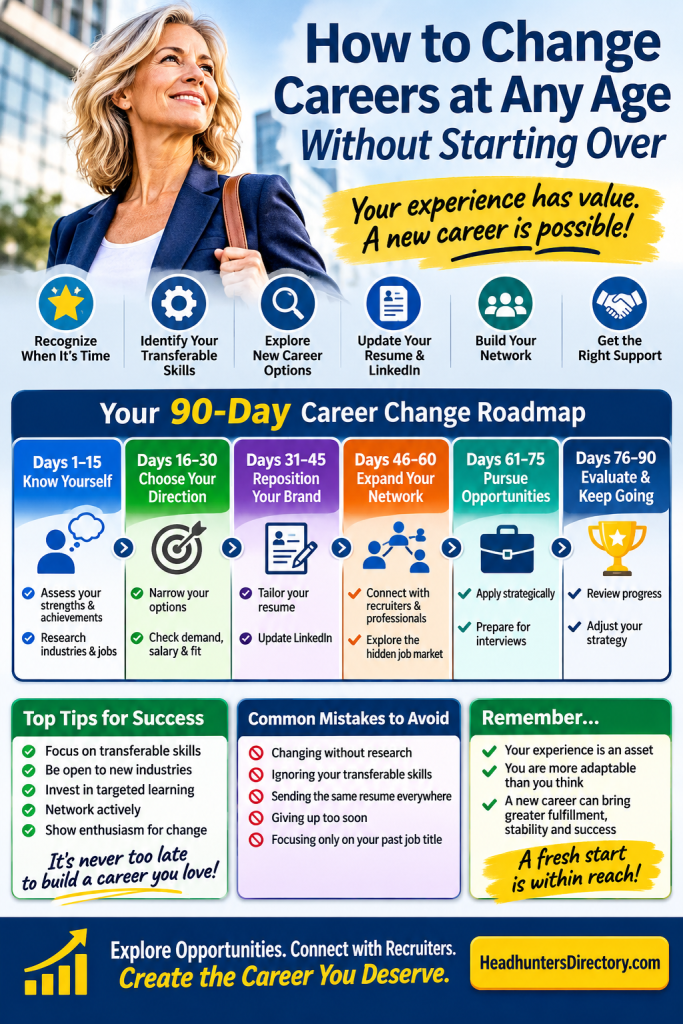
If you are serious about moving into a new profession, it helps to have a structured plan.
The following 90 day roadmap provides a practical starting point.
Days 1 to 15: Understand Your Strengths and Explore Opportunities
Begin by evaluating your professional background.
Identify your strongest transferable skills, accomplishments, technical abilities and areas of expertise.
Research potential occupations and identify three to five industries or professions that interest you.
Read job advertisements and determine which qualifications employers are seeking.
At the end of this period, you should have a clearer understanding of your options and the types of positions you want to pursue.
Days 16 to 30: Select Your Target Career
Narrow your choices to one or two realistic career directions.
Research salary expectations, employment opportunities, qualifications and potential employers.
Speak with professionals already working in your target industry.
Determine whether you need additional education, certification or technical training.
Create a realistic plan for addressing any important skill gaps.
Days 31 to 45: Reposition Your Professional Brand
Rewrite your resume to emphasize transferable skills and relevant accomplishments.
Update your LinkedIn profile and professional introduction.
Prepare a compelling explanation of why you are changing careers.
Develop examples demonstrating how your previous experience can benefit an employer in your target industry.
Days 46 to 60: Build Your Professional Network
Identify recruitment agencies and headhunters specializing in your target industry.
Connect with relevant recruiters and explain your career objectives.
Reach out to former colleagues, professional contacts and industry acquaintances.
Research employers that hire for the positions you are pursuing.
Begin developing relationships rather than relying exclusively on online applications.
Days 61 to 75: Pursue Relevant Opportunities
Begin submitting carefully targeted applications.
Contact recruiters who may be able to introduce you to suitable employers.
Participate in networking activities and professional discussions.
Prepare thoroughly for interviews.
Use feedback to improve how you communicate your experience and explain your career transition.
Days 76 to 90: Evaluate, Improve and Expand Your Search
Review your progress.
Are employers responding positively? Are you securing interviews? Are recruiters identifying relevant opportunities?
If you are not getting results, examine your approach.
You may need to revise your resume, expand your target occupations, address a qualification gap or improve how you communicate your transferable skills.
Continue building professional relationships and pursuing relevant opportunities.
Remember that changing careers is not always completed within 90 days. The purpose of this plan is to establish momentum, provide direction and help you make measurable progress.
17. Frequently Asked Questions About Changing Careers
Is it too late to change careers at 40 or 50?
No. People successfully change professions at different stages of their working lives. Your experience, maturity, professional judgment and transferable skills can be valuable to employers in many industries. The key is identifying realistic opportunities and presenting your background effectively.
What is the easiest career to transition into?
There is no universally easiest career to enter. The most straightforward transition is often into a profession that uses skills you have already developed. Someone with management experience may find operations or project coordination more accessible than an entirely unrelated technical occupation.
Can I change careers without going back to school?
Yes. Many career transitions are possible through transferable experience, professional development, short courses and employer training. However, some occupations require specific qualifications, licensing or formal education. Research your target profession before making a decision.
How do I change careers when employers want experience I do not have?
Focus on demonstrating relevant transferable skills and accomplishments. Look for related positions, contract opportunities and employers willing to consider candidates from different industries. Explain how your existing capabilities can help you succeed in the new position.
Should I take a pay cut when changing careers?
Not necessarily. Your experience may qualify you for positions with compensation comparable to your current salary. However, some transitions involve an initial reduction in earnings, particularly when entering a profession with different qualifications or responsibilities. Evaluate the long term financial benefits before making a decision.
How do I explain a career change during an interview?
Explain what attracted you to the new profession, how your existing experience relates to the position and why you believe you can contribute. Focus on positive reasons for making the transition rather than criticizing your previous employer or occupation.
Can a recruiter help me change industries?
Yes. Recruiters who specialize in your target industry may help identify suitable positions, explain employer expectations and introduce you to organizations that could value your background. Look for recruitment professionals who understand your desired occupation and are open to considering transferable experience.
What if I do not know what career I want?
Start by evaluating your interests, strengths, preferred working environment and financial objectives. Research different occupations and speak with people working in fields that interest you. You do not need to identify your perfect career immediately. Exploring several realistic possibilities can help you make a more informed decision.
Is changing careers worth the risk?
For many people, it can be. Remaining in an occupation that offers little satisfaction or future opportunity also carries risks. A carefully researched transition can provide improved professional satisfaction, better opportunities, new challenges and a more rewarding working life. Evaluate the financial and personal implications before making a major decision.
How long does it take to change careers?
It depends on the profession, your existing qualifications, the demand for workers and the amount of additional training required. Some people transition within a few months, while others need a year or longer. Establishing a realistic plan and consistently pursuing opportunities can help accelerate the process.
Your Next Career Could Be Better Than You Imagine
One of the biggest obstacles to changing careers is not a lack of qualifications, experience or ability. It is the belief that you are somehow too far into your existing profession to do anything different.
That belief can prevent talented people from pursuing opportunities that could significantly improve their professional and personal lives.
Think about everything you have accomplished throughout your working life. Every challenge you have overcome, every difficult decision you have made, every customer you have helped, every project you have completed and every responsibility you have accepted has contributed to the professional you are today.
Those experiences have value.
You do not need to discard your professional history to build a different future. You need to recognize what you have learned, understand where those capabilities can be applied and communicate your potential to employers who are willing to look beyond traditional career paths.
There are organizations looking for people who can lead, solve problems, build relationships, improve operations, develop business and make meaningful contributions. Some of those opportunities may exist in industries you have never seriously considered.
Take the time to explore them.
If you are ready to make a change, start by identifying your strengths, researching your options and connecting with professionals who understand your target industry.
Your next career does not have to be a continuation of your previous one. It can be the beginning of something considerably better.
And remember, you do not have to navigate the journey alone.
HeadhuntersDirectory.com is a resource for connecting with headhunters, executive recruiters and recruitment agencies that work with employers across numerous industries and professional fields. Whether you are pursuing a new occupation, entering a different industry or looking for a position that makes better use of your experience, connecting with the right recruitment professionals can help you explore the opportunities ahead.
Your experience has value. Your potential is not limited by your previous job title. And it is never too late to take the next step toward a career you genuinely look forward to.
Top Interview Questions and Best Answers!
How to Answer “Tell Me About a Challenge or Conflict?”
How to Answer “Can You Tell Me About a Time You Disagreed With Your Manager?”
How to Best Answer “Why Did You Leave Your Last Job?”
How to Answer “Do You Have Any Questions for Us?”
How to Answer “Tell Me About Yourself”
How to Answer “What motivates you?”
How to Answer “How do you handle feedback or criticism?”
20 Secret Signs You Aced the Interview!
How to Answer “How Would Your Previous Employer Describe You?
How to Answer “What makes you unique?”
How to Answer “How Do You Handle Stress or Pressure?”
How to Answer “How do you stay organized?”
How to Answer “Why do you want to work for us?”
How to Answer “What do you know about our company?”
How to Answer “What are your career goals”
How to Answer “Can You Describe a time you helped resolve a conflict?”
How to Answer “Are you willing to relocate?”
How to Answer “What Are Your Long Term Goals?”
How to Answer “Tell me about a time you took initiative”
How to Answer “Are you willing to travel for work?”
How to Answer “How do you prioritize your work?”
How to Answer “How do you manage competing priorities?”
How to Answer “Tell me about a time you taught or mentored someone.”
How to Answer “What Accomplishments Are You Most Proud Of?”
How to Answer “Describe How You Handled a High Pressure Situation”
How to Answer “What Are Your Hobbies or Interests?” in a Job Interview
How to Answer “What would you look to accomplish in your first 90 days?”
How to Answer “What did you like least about your last job?”
How to Answer “What are your passions?” In Job Interview
How to Answer “Describe a time you worked as part of a team.”
How to Answer “What did you like most about your last job?”
How to Answer “How Would You Adapt to Change at Work?” in a Job Interview
How to Answer “How do you stay current with industry trends?” in a Job Interview
How to Answer “What leadership style works best for you?” in a Job Interview
How to Answer “Describe a Time You Failed and What You Learned” in a Job Interview
How to Answer “What Challenges Are You Looking For?” in a Job Interview
How to Answer “What was the last goal you set and how did you achieve it?” in a Job Interview
How to Answer “Tell me about a time you disagreed with a colleague.” in a Job Interview
Here are some great additional article that you will find very helpful as you polish that resume:
Cover Letter Mistakes to Avoid
Best Transferable Skills for Resumes
The 6-Second Resume Test: How Recruiters Screen Candidates
Resume Action Words & Power Verbs: Tips & Examples
What Not To Put on a Resume Tips to Ensure Your Resume Works
Get Noticed by Executive Search Firms: A Step by Step Guide
10 Most Sought After Soft Skills Employers Love
The Worst Things to Put on a Resume (and What to Do Instead)
Why Your Resume Isn’t Getting Noticed and How Recruiters Can Change That
How Long Should a Resume Be? Tips for Today’s Candidates
10 Very Common Resume Mistakes and How To Avoid Them
Do Headhunters and Recruiters Prefer Shorter Resumes?
More Great Articles For You!
- How Long Should a Resume Be? Tips for Today’s Candidates
- Job Interview Secrets
- How to Dress For Your Interview
- How to Stay Positive and Motivated During Your Job Search
- How To Succeed in Todays Job Market
- Top Job Search Sites in USA
- Top Job Search Sites in Canada
- Top Job Search Sites in UK
- Top Job Search Sites in Australia
- Best-Paying Jobs That Don’t Require a Degree!
- Top 25 Highest-Paying Jobs You Can Land Through a Headhunter
- 100 Jobs That Pay $100K or More: A Guide for Ambitious Job Seekers
- Jobs That Pay 200K or More
- Jobs That Pay $500K or More
- Most Endangered Jobs Because of AI
- Benefits of Using Local Headhunters and Recruiters
Visit HeadhuntersDirectory.com today to connect with trusted recruiters, headhunters, and executive search firms across the USA, Canada, the UK, and Australia. Find your match, grow your network, and discover opportunities you didn’t even know existed.

- How to Change Careers at Any Age Without Starting Over

- Hidden Cost of an Unfilled Position | Employer Hiring Guide

- 25 Questions to Ask Before Accepting a Job Offer

- How to Spot Fake Recruiters and Job Scams: 15 Warning Signs

- Ghost Jobs: Why Companies Advertise Jobs They Aren’t Filling

- How Executive Recruiters Unlock Jobs You Will Never Find Online

- 10 Signs It’s Time to Leave Your Job Even If the Money Is Great

- How Recruiters Actually Read Your Resume in 30 Seconds

- 10 Reasons Why Recruiters Never Call Qualified Candidates