How Executive Search Firms Find Candidates Who Never Apply
Executive search firms find candidates who never apply by building long term relationships, conducting industry research, mapping talent markets, leveraging referrals, evaluating leadership potential, and maintaining extensive professional networks. Learn how executive recruiters discover hidden talent and why HeadhuntersDirectory.com is the best place to connect directly with executive search firms.

Executive Search Firms Find Candidates Who Never Even Apply!
Finding exceptional talent is one of the biggest challenges facing employers today. While many companies focus on posting jobs and waiting for applications, executive search firms operate very differently. Their success comes from identifying and engaging professionals who are already thriving in their careers and have no intention of searching job boards.
These professionals are often called passive candidates. They are experienced, respected, and highly successful. Because they are not actively looking for work, employers rarely have the opportunity to reach them through traditional recruiting methods. Executive search firms specialize in building relationships with these individuals long before a hiring need arises.
Understanding how executive search firms find candidates who never apply provides valuable insight for employers, executives, managers, and job seekers alike. It also explains why working with an executive search firm often results in stronger hires, faster placements, and better long term career opportunities.
Whether you are hiring executive talent or hoping to be discovered for your next leadership opportunity, learning how this process works can give you a significant advantage.
What Is an Executive Search Firm
Executive search firms specialize in recruiting senior level professionals, executives, directors, vice presidents, and highly specialized experts. Unlike traditional recruiting agencies that often fill large numbers of positions, executive search firms focus on finding the best possible individual for a specific leadership role.
Their assignments typically involve positions where experience, leadership ability, technical expertise, and cultural fit are essential. Companies hire executive search firms because they need someone who can identify exceptional candidates rather than simply reviewing incoming resumes.
The search process is highly strategic and often involves weeks or months of research, networking, interviews, and confidential discussions.
Why the Best Candidates Rarely Apply
One of the biggest misconceptions in recruiting is that the best professionals are actively searching for jobs.
In reality, many top performers are already employed in rewarding positions. They enjoy competitive salaries, strong benefits, challenging projects, and supportive leadership. They have little reason to browse job boards or submit resumes.
However, that does not mean they are unwilling to consider a truly outstanding opportunity.
Executive search firms understand this difference. Instead of waiting for candidates to apply, they proactively introduce career opportunities that may offer greater responsibility, stronger compensation, improved work life balance, or a more exciting future.
The Hidden Talent Market
A significant percentage of experienced professionals never submit online applications.
Instead, they change jobs because someone they trust reaches out to them with the right opportunity.
Executive search firms spend years developing relationships within this hidden market.
Extensive Industry Research
One of the first steps executive search firms take is conducting detailed industry research.
Rather than searching only for people with matching job titles, they analyze entire industries to identify organizations that consistently produce exceptional talent.
They study market leaders, fast growing companies, innovative startups, respected competitors, and organizations known for developing outstanding employees.
This research allows recruiters to identify where top talent is currently working.
Mapping Entire Industries
Executive search firms frequently perform what is known as market mapping.
Market mapping involves identifying companies, departments, reporting structures, leadership teams, and high performing professionals across an industry.
Instead of looking for one candidate, recruiters build a complete picture of the available talent.
This information becomes incredibly valuable when future search assignments begin because much of the research has already been completed.
Building Relationships Before Jobs Exist
One of the greatest strengths of executive search firms is relationship building.
Experienced executive recruiters spend years developing professional relationships with executives across multiple industries.
These conversations often occur long before any job opportunity exists.
Recruiters regularly check in with industry leaders, discuss market trends, exchange career advice, and learn about changing business priorities.
Because trust already exists, candidates are more willing to explore opportunities when the right role appears.
Professional Networking
Networking remains one of the most effective recruiting tools available.
Executive search consultants maintain extensive networks built through years of recruiting, conferences, professional associations, referrals, executive events, and industry relationships.
Every successful placement expands these networks even further.
Former candidates frequently become future clients, hiring managers, or referral sources.
This creates an ongoing cycle of relationship building that benefits both employers and candidates.
Employee Referrals
Top professionals often know other top professionals.
Executive search firms regularly ask trusted contacts for recommendations.
These referrals often identify exceptional individuals who have never spoken with recruiters before.
Since recommendations come from respected colleagues, candidates are often much more receptive to confidential conversations.
Referral based recruiting consistently produces some of the strongest executive candidates.
Long Term Candidate Databases
Executive search firms maintain extensive candidate databases that grow over many years.
These databases include executives interviewed during previous searches, industry contacts, referrals, conference attendees, and professionals identified through research.
Every conversation adds valuable information about experience, leadership style, career goals, industry expertise, and future interests.
When a new assignment begins, recruiters can immediately identify individuals who may be an excellent fit.
Continuous Market Intelligence
Executive recruiters constantly monitor industry developments.
They watch executive promotions, company expansions, mergers, acquisitions, leadership changes, new product launches, funding announcements, and organizational restructuring.
These business events often create opportunities for talented professionals to consider new career paths.
Staying informed allows recruiters to approach candidates at the right moment.
Confidential Conversations
Many executive searches remain confidential.
Companies may be replacing an executive who is still employed or creating a strategic leadership role that has not yet been announced.
Executive search firms protect both employers and candidates by conducting confidential discussions throughout the hiring process.
Candidates can explore opportunities without risking their current employment.
This level of confidentiality encourages more experienced professionals to participate.
Understanding Career Motivations
Executive search firms know that salary is only one factor influencing career decisions.
Many senior professionals are motivated by opportunities to build teams, influence company strategy, develop innovative products, improve organizational culture, or solve significant business challenges.
Experienced recruiters spend time understanding what truly motivates each candidate.
When a new opportunity aligns with those goals, candidates become much more interested in learning more.
Evaluating Leadership Potential
Finding candidates is only the beginning.
Executive search firms also evaluate leadership capabilities.
Recruiters assess communication skills, strategic thinking, decision making ability, emotional intelligence, adaptability, integrity, collaboration, and long term leadership potential.
These qualities are often more important than technical qualifications alone.
Companies benefit from candidates who can lead organizations through growth and change.
Assessing Cultural Fit
An impressive resume does not guarantee success.
Executive search firms carefully evaluate whether a candidate fits the organization’s culture, leadership style, values, and long term objectives.
A strong cultural fit improves employee engagement, retention, collaboration, and organizational performance.
This additional level of evaluation significantly reduces hiring risk.
Looking Beyond Resume Keywords
Many online recruiting systems rely heavily on keyword matching.
Executive search firms take a completely different approach.
Recruiters evaluate accomplishments, business impact, leadership achievements, innovation, revenue growth, operational improvements, team development, and strategic contributions.
They look beyond titles to understand the actual value each executive has created throughout their career.
Maintaining Ongoing Relationships
The recruiting process rarely ends after a placement.
Executive search firms continue building relationships with candidates for years.
They stay informed about promotions, career achievements, changing interests, and future goals.
This ongoing communication makes future searches faster and more effective.
Candidates also benefit by having trusted advisors throughout their careers.
Using Reputation as a Recruiting Tool
Well established executive search firms develop strong reputations within their industries.
Candidates are more willing to speak with recruiters they know and trust.
A respected recruiter often receives responses from executives who ignore unsolicited messages from unknown recruiters.
Trust plays a major role in executive recruiting success.
Understanding Business Challenges
Executive recruiters spend considerable time understanding each client’s business.
They learn about company culture, strategic priorities, competitive challenges, leadership expectations, financial goals, and future growth plans.
This knowledge helps recruiters identify candidates capable of solving specific business problems rather than simply filling vacancies.
The result is stronger long term hiring outcomes.
Identifying Transferable Leadership Skills
Many executive placements come from outside a company’s immediate industry.
Executive search firms recognize leadership abilities that transfer successfully between sectors.
An experienced operations executive, technology leader, finance professional, or sales executive may thrive in a completely different industry because their leadership capabilities remain highly valuable.
This broader perspective expands the available talent pool.
Timing Matters
The best opportunity presented at the wrong time may still receive a polite decline.
Executive search firms understand that career decisions depend heavily on timing.
They remain patient, maintain relationships, and reconnect when circumstances change.
An executive who declines today may become an enthusiastic candidate six months later.
Patience is one of the defining characteristics of successful executive recruiting.
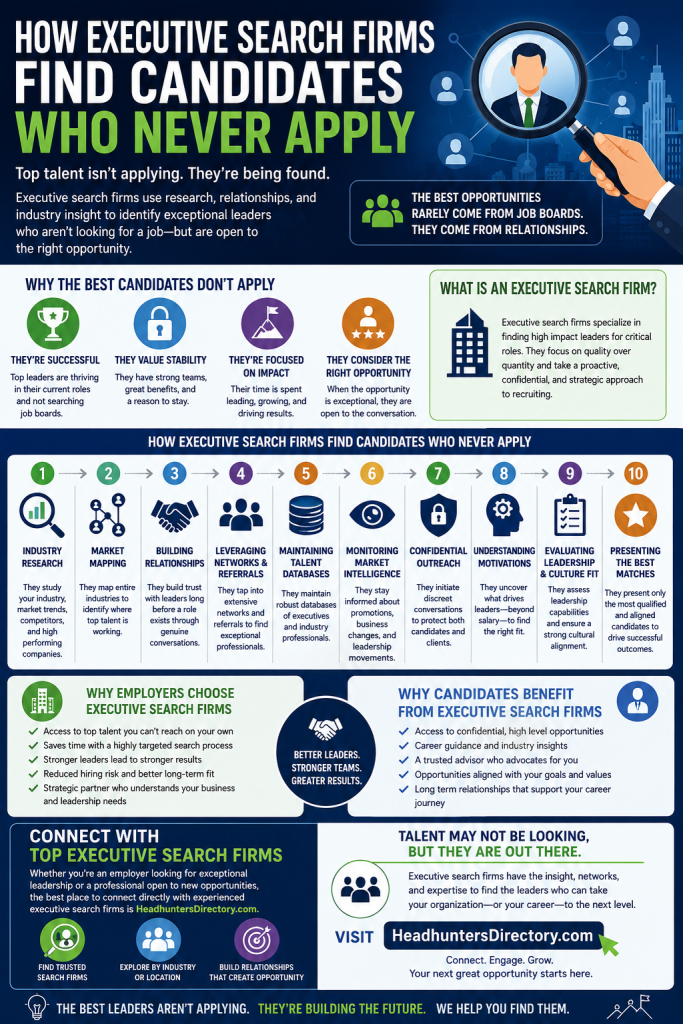
Why Employers Choose Executive Search Firms
Organizations invest in executive search firms because the stakes are extremely high when hiring senior leaders.
The cost of hiring the wrong executive can be enormous.
Executive search firms reduce this risk by identifying stronger candidates, conducting extensive evaluations, and presenting only highly qualified leaders.
Why Candidates Benefit From Executive Search Firms
Working with an executive search firm offers advantages even when you are not actively searching for a new position.
Recruiters provide insight into industry trends, compensation expectations, leadership opportunities, and career progression.
They may introduce confidential executive positions that never appear on public job boards.
Building relationships with executive search firms ensures you remain visible when exceptional opportunities arise.

Best Place to Connect With Executive Search Firms: HeadhuntersDirectory.com
The Best Place to Connect With Executive Search Firms
The directory makes it easy for employers seeking exceptional leadership talent and professionals exploring confidential career opportunities to discover executive search firms across a wide range of industries and locations.
Rather than waiting to be discovered, professionals can proactively build relationships with executive recruiters, while employers can quickly identify experienced search firms that specialize in finding difficult to reach executive talent.
How to Increase Your Visibility to Executive Search Firms
Even if you are not actively searching for a new job, there are several ways to become more visible to executive recruiters.
Maintain an updated professional profile that clearly highlights your accomplishments, leadership experience, and measurable business results.
Develop a strong reputation within your industry by speaking at events, publishing insightful content, mentoring others, and participating in professional organizations.
Build genuine relationships with recruiters before you need them. Staying connected makes it much easier for executive search firms to contact you when exceptional opportunities become available.
Continue expanding your expertise through professional development, certifications, and leadership experience. Candidates who consistently invest in their careers naturally attract greater attention from executive recruiters.
The Future of Executive Search
Technology continues to improve executive recruiting, but relationships remain the foundation of successful executive search.
Artificial intelligence, advanced research tools, and sophisticated talent databases help recruiters identify candidates more efficiently, yet trust, experience, judgment, and personal relationships still determine hiring success.
The organizations that consistently hire exceptional leaders understand that executive recruiting is about much more than reviewing resumes. It is about finding individuals capable of transforming businesses and leading teams toward long term success.
Likewise, professionals who build relationships with respected executive search firms position themselves for opportunities that many other candidates never even know exist.
Frequently Asked Questions
Do executive search firms only recruit executives?
No. While many focus on executive leadership roles, some also recruit directors, senior managers, highly specialized professionals, and technical experts depending on their area of expertise.
Can someone contact an executive search firm without looking for a new job?
Yes. Building a relationship before you need a new opportunity is often one of the smartest career moves you can make. Recruiters can keep you in mind for future confidential opportunities that match your experience.
Why do executive search firms contact people who are already employed?
The strongest candidates are often already succeeding in their current positions. Executive search firms actively seek these professionals because they frequently bring proven leadership, experience, and measurable business results.
How do executive search firms keep searches confidential?
Executive recruiters conduct private discussions, carefully protect client information, and only share details with qualified candidates at appropriate stages of the recruiting process. This allows both employers and candidates to explore opportunities discreetly.
Is it worth building relationships with executive recruiters?
Absolutely. Long term relationships with executive recruiters can provide valuable career advice, market insights, compensation information, and access to executive opportunities that are never publicly advertised.
Build Relationships Before Opportunity Knocks
The most successful executive careers are rarely built through online job applications alone. They are often shaped through trusted relationships, professional reputation, and conversations that begin long before a position becomes available.
Executive search firms excel because they invest in people, understand industries, and maintain networks that reach far beyond traditional recruiting methods. Their ability to identify exceptional candidates who never apply gives employers access to leadership talent that competitors often miss.
Whether you are an employer searching for transformational leaders or a professional preparing for your next executive opportunity, developing relationships with experienced executive search firms can create opportunities that might otherwise remain hidden. If you want to connect directly with respected executive search firms, recruiters, and executive recruiting specialists, HeadhuntersDirectory.com is an outstanding resource for discovering firms that can help you achieve your hiring or career goals.
Top Interview Questions and Best Answers!
How to Answer “Tell Me About a Challenge or Conflict?”
How to Answer “Can You Tell Me About a Time You Disagreed With Your Manager?”
How to Best Answer “Why Did You Leave Your Last Job?”
How to Answer “Do You Have Any Questions for Us?”
How to Answer “Tell Me About Yourself”
How to Answer “What motivates you?”
How to Answer “How do you handle feedback or criticism?”
20 Secret Signs You Aced the Interview!
How to Answer “How Would Your Previous Employer Describe You?
How to Answer “What makes you unique?”
How to Answer “How Do You Handle Stress or Pressure?”
How to Answer “How do you stay organized?”
How to Answer “Why do you want to work for us?”
How to Answer “What do you know about our company?”
How to Answer “What are your career goals”
How to Answer “Can You Describe a time you helped resolve a conflict?”
How to Answer “Are you willing to relocate?”
How to Answer “What Are Your Long Term Goals?”
How to Answer “Tell me about a time you took initiative”
How to Answer “Are you willing to travel for work?”
How to Answer “How do you prioritize your work?”
How to Answer “How do you manage competing priorities?”
How to Answer “Tell me about a time you taught or mentored someone.”
How to Answer “What Accomplishments Are You Most Proud Of?”
How to Answer “Describe How You Handled a High Pressure Situation”
How to Answer “What Are Your Hobbies or Interests?” in a Job Interview
How to Answer “What would you look to accomplish in your first 90 days?”
How to Answer “What did you like least about your last job?”
How to Answer “What are your passions?” In Job Interview
How to Answer “Describe a time you worked as part of a team.”
How to Answer “What did you like most about your last job?”
How to Answer “How Would You Adapt to Change at Work?” in a Job Interview
How to Answer “How do you stay current with industry trends?” in a Job Interview
How to Answer “What leadership style works best for you?” in a Job Interview
How to Answer “Describe a Time You Failed and What You Learned” in a Job Interview
How to Answer “What Challenges Are You Looking For?” in a Job Interview
How to Answer “What was the last goal you set and how did you achieve it?” in a Job Interview
How to Answer “Tell me about a time you disagreed with a colleague.” in a Job Interview
Here are some great additional article that you will find very helpful as you polish that resume:
Cover Letter Mistakes to Avoid
Best Transferable Skills for Resumes
The 6-Second Resume Test: How Recruiters Screen Candidates
Resume Action Words & Power Verbs: Tips & Examples
What Not To Put on a Resume Tips to Ensure Your Resume Works
Get Noticed by Executive Search Firms: A Step by Step Guide
10 Most Sought After Soft Skills Employers Love
The Worst Things to Put on a Resume (and What to Do Instead)
Why Your Resume Isn’t Getting Noticed and How Recruiters Can Change That
How Long Should a Resume Be? Tips for Today’s Candidates
10 Very Common Resume Mistakes and How To Avoid Them
Do Headhunters and Recruiters Prefer Shorter Resumes?
More Great Articles For You!
- How Long Should a Resume Be? Tips for Today’s Candidates
- Job Interview Secrets
- How to Dress For Your Interview
- How to Stay Positive and Motivated During Your Job Search
- How To Succeed in Todays Job Market
- Top Job Search Sites in USA
- Top Job Search Sites in Canada
- Top Job Search Sites in UK
- Top Job Search Sites in Australia
- Best-Paying Jobs That Don’t Require a Degree!
- Top 25 Highest-Paying Jobs You Can Land Through a Headhunter
- 100 Jobs That Pay $100K or More: A Guide for Ambitious Job Seekers
- Jobs That Pay 200K or More
- Jobs That Pay $500K or More
- Most Endangered Jobs Because of AI
- Benefits of Using Local Headhunters and Recruiters
Visit HeadhuntersDirectory.com today to connect with trusted recruiters, headhunters, and executive search firms across the USA, Canada, the UK, and Australia. Find your match, grow your network, and discover opportunities you didn’t even know existed.

- How Executive Recruiters Unlock Jobs You Will Never Find Online

- 10 Signs It’s Time to Leave Your Job Even If the Money Is Great

- How Recruiters Actually Read Your Resume in 30 Seconds

- 10 Reasons Why Recruiters Never Call Qualified Candidates

- 12 Things You Should Never, Ever Say to Your Boss

- Why Networking Still Beats Applying Online

- What Recruiters Wish Every Candidate Knew 15 Insider Tips for Job Seekers

- Why Applying to Hundreds of Jobs Rarely Works

- The Complete Guide to Recruiter Red Flags