6 Seconds Before a Resume Is Rejected or Accepted!
6 Seconds: How Recruiters Decide to Reject or Read Your Resume
Recruiters scan resumes in just 6 seconds. Discover what they look for, why most resumes fail, and how to pass the 6-second resume test.

You have about 6 Seconds Before a Resume Is Rejected or Accepted!
Six seconds.
That is the average amount of time a recruiter or hiring manager spends deciding whether your resume deserves further attention or immediate rejection. In that brief window, your resume is not being read. It is being judged.
Before your experience is fully reviewed, before your skills are appreciated, and before your potential is considered, your resume must pass one critical test: instant clarity.
Understanding how those six seconds work, and how recruiters think during them, is one of the most valuable advantages a job seeker can have.
Why Recruiters Spend Only 6 Seconds on a Resume
Recruiters are not careless. They are constrained by volume and time.
A single open role can generate hundreds or even thousands of applications. Internal recruiters often manage multiple roles simultaneously, while agency recruiters are balancing dozens of searches under strict deadlines.
As a result, resumes are scanned rapidly to identify immediate alignment.
In those first six seconds, recruiters are not asking:
“Is this candidate perfect?”
They are asking:
“Is this candidate clearly worth my time?”
If the answer is not obvious, the resume is rejected and the recruiter moves on.
What Happens During the 6-Second Resume Scan
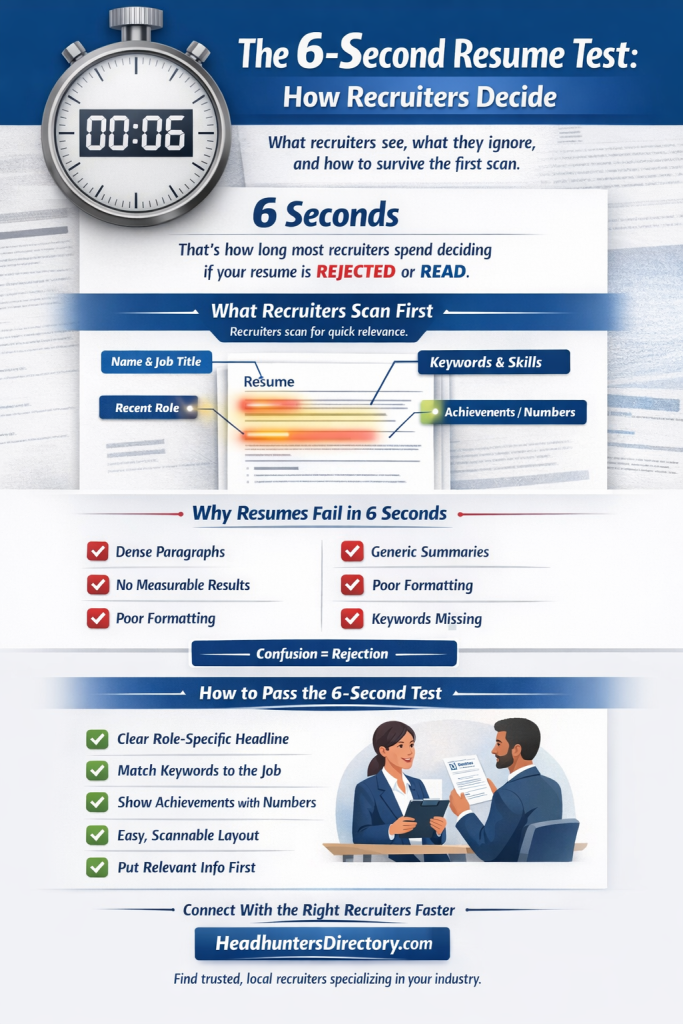
During this initial scan, recruiters focus on a predictable set of elements:
- Current or recent job title
- Alignment with the target role
- Keywords that match the job description
- Scope and seniority of experience
- Evidence of impact or results
- Overall structure and readability
If these signals are easy to spot, the recruiter continues reading. If they are hidden, unclear, or missing, the resume is filtered out, regardless of the candidate’s true capability.
100+ Best ATS Keywords to Help You Pass ATS
Best Transferable Skills for Resumes
Why Most Resumes Are Rejected Instantly
Most resumes fail not because the candidate lacks experience, but because the resume fails to communicate relevance fast enough.
Common reasons resumes are rejected within seconds include:
- Long paragraphs that require effort to read
- Generic summaries that could apply to anyone
- Key achievements buried deep in the document
- Mismatch between resume language and job description
- Overloaded resumes trying to include everything
- Poor formatting that disrupts scanning
In a high-volume hiring environment, confusion equals rejection.
How Far Back Should a Resume Go?
How to Make Your Resume Pass the 6-Second Test
1. Open With a Role-Specific Professional Headline
Your resume should immediately tell the recruiter who you are and where you fit.
Avoid vague labels such as:
“Professional Summary” or “Results-Oriented Professional”
Instead, lead with a clear, targeted headline:
- Senior Marketing Manager – B2B Growth and Demand Generation
- IT Project Manager – ERP and Digital Transformation
- Human Resources Business Partner – Employee Relations and Talent Strategy
This alone can determine whether your resume survives the initial scan.
2. Align Your Resume Language With the Job Description
Job descriptions reveal exactly what employers value.
Recruiters scan resumes for familiar terminology, skills, and phrases. If the posting emphasizes leadership, analytics, compliance, or client management, your resume should reflect those priorities using similar language.
This alignment is essential not only for recruiters, but also for applicant tracking systems that filter resumes before a human ever sees them.
3. Highlight Achievements, Not Just Responsibilities
Recruiters want to see evidence of impact quickly.
Compare the difference:
Weak:
“Responsible for managing a sales team.”
Strong:
“Led a team of 12 sales representatives, increasing quarterly revenue by 22 percent.”
Metrics, outcomes, and scope stand out immediately and signal competence at a glance.
Should executives have longer resumes?
4. Surface Your Most Relevant Experience First
Your resume should be ordered by relevance, not habit.
If certain roles, projects, or achievements are highly applicable to the position you are targeting, they should be prominent and easy to find, even if they are not from your most recent role.
Recruiters should never have to search for reasons to interview you.
How To Handle Employment Gaps On Your Resume
5. Design for Speed and Simplicity
Recruiters value clarity over creativity.
Effective resumes share common traits:
- Clean section headings
- Consistent formatting
- Bullet points instead of dense text
- Adequate white space
- Easy-to-read fonts
Highly stylized or graphic-heavy resumes often slow scanning and reduce comprehension, especially in corporate and executive hiring environments.
Cover Letter Mistakes to Avoid
How to Answer “Why Should We Hire You?”
6. Remove Anything That Does Not Strengthen Your Case
In six seconds, every line must add value.
Consider removing:
- Objective statements
- Irrelevant early-career roles
- Outdated skills
- Soft skills without evidence
- Buzzwords with no context
A focused resume is more powerful than a comprehensive one.
What Employers Look for in Candidates: Top Skills Headhunters Seek
Why Working With Recruiters Changes the Equation
Even a strong resume performs better when paired with the right recruiter.
Recruiters provide insight into what hiring managers actually want, how resumes are evaluated in their market, and how to position your experience effectively.
This is why connecting with specialized, local recruiters is a critical part of a serious job search.
HeadhuntersDirectory.com is one of the best resources available to job seekers looking to connect with reputable recruiters and headhunters in their specific industry and location. Instead of blindly applying online, the platform allows you to identify recruiters who actively work with employers in your field and understand local hiring trends.
When your resume is submitted by a trusted recruiter, it often receives more attention, more context, and more consideration than a cold application.

Ensure Your Resume is NOT Rejected!
The Real Truth About Resume Rejection
Resume rejection is rarely personal.
It is structural.
Recruiters are not rejecting your potential. They are rejecting uncertainty, irrelevance, and lack of clarity under time pressure.
Your goal is not to explain everything. Your goal is to make your value unmistakable at a glance.
When your resume clearly demonstrates fit, impact, and relevance, six seconds becomes thirty. Thirty seconds becomes a full review. A full review becomes an interview.
Treat Your Resume Like a Business Asset
Your resume is not a life story. It is not a record of everything you have ever done.
It is a strategic document designed to pass a six-second filter.
Combined with a focused job search strategy and the right recruiter connections through platforms like HeadhuntersDirectory.com, your resume becomes a powerful tool rather than a silent barrier.
Six seconds decide whether you move forward or disappear into the rejection pile.
Make every second work for you.
Here are some great additional article that you will find very helpful as you polish that resume:
Resume Action Words & Power Verbs: Tips & Examples
What Not To Put on a Resume Tips to Ensure Your Resume Works
Get Noticed by Executive Search Firms: A Step by Step Guide
10 Most Sought After Soft Skills Employers Love
The Worst Things to Put on a Resume (and What to Do Instead)
Why Your Resume Isn’t Getting Noticed and How Recruiters Can Change That
How Long Should a Resume Be? Tips for Today’s Candidates
10 Very Common Resume Mistakes and How To Avoid Them
Do Headhunters and Recruiters Prefer Shorter Resumes?
More Great Articles For You!
- How Long Should a Resume Be? Tips for Today’s Candidates
- Job Interview Secrets
- How to Dress For Your Interview
- How to Stay Positive and Motivated During Your Job Search
- How To Succeed in Todays Job Market
- Top Job Search Sites in USA
- Top Job Search Sites in Canada
- Top Job Search Sites in UK
- Top Job Search Sites in Australia
- Best-Paying Jobs That Don’t Require a Degree!
- Top 25 Highest-Paying Jobs You Can Land Through a Headhunter
- 100 Jobs That Pay $100K or More: A Guide for Ambitious Job Seekers
- Jobs That Pay 200K or More
- Jobs That Pay $500K or More
- Most Endangered Jobs Because of AI
- Benefits of Using Local Headhunters and Recruiters
Visit HeadhuntersDirectory.com today to connect with trusted recruiters, headhunters, and executive search firms across the USA, Canada, the UK, and Australia. Find your match, grow your network, and discover opportunities you didn’t even know existed.

- How Executive Recruiters Unlock Jobs You Will Never Find Online

- 10 Signs It’s Time to Leave Your Job Even If the Money Is Great

- How Recruiters Actually Read Your Resume in 30 Seconds

- 10 Reasons Why Recruiters Never Call Qualified Candidates

- 12 Things You Should Never, Ever Say to Your Boss

- Why Networking Still Beats Applying Online

- What Recruiters Wish Every Candidate Knew 15 Insider Tips for Job Seekers

- Why Applying to Hundreds of Jobs Rarely Works

- The Complete Guide to Recruiter Red Flags