What Not To Put on a Resume
What should you not put on a resume? Avoid personal details, generic objectives, outdated experience, weak skills, salary information, excessive formatting, and false claims. Removing these resume killers helps your qualifications stand out, improves ATS compatibility, and significantly increases your chances of landing interviews.

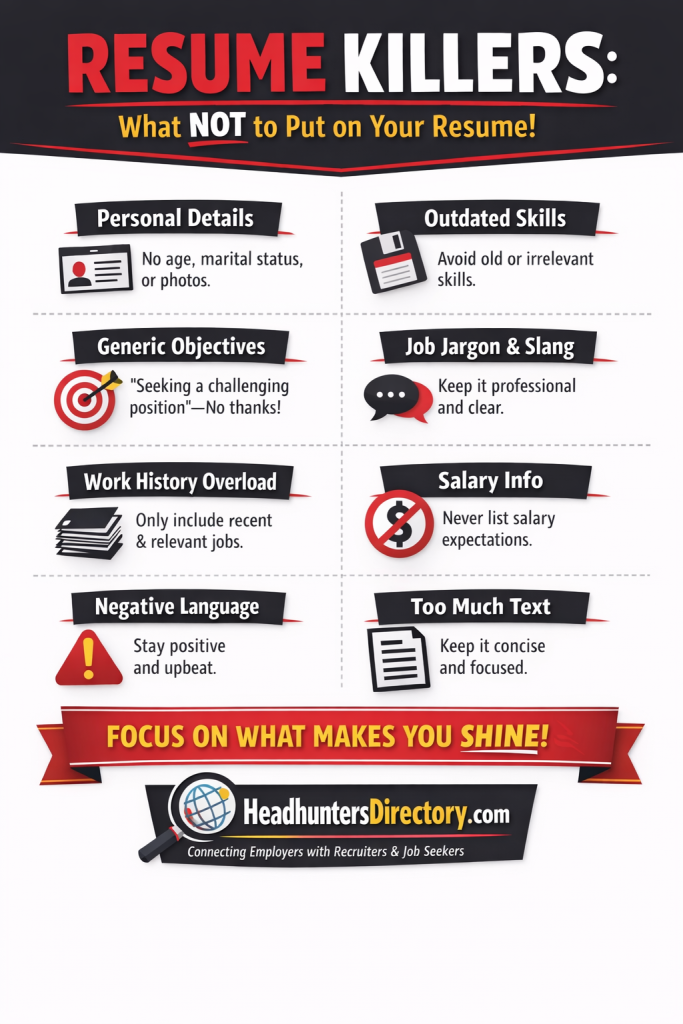
Resume Killers What NOT to Put on a Resume
A resume is not a life story. It is a strategic marketing document designed to earn one result: an interview. Hiring managers often spend 6–10 seconds scanning a resume before deciding whether to continue reading. That means what you leave out is just as important as what you include.
This guide breaks down exactly what not to put on a resume, explains why each item hurts your chances, and shows you how to replace weak content with high-impact alternatives. If you want a resume that gets noticed, read this carefully.
Resume Killers To Avoid: What Not to Put on a Resume
1. Personal Information That Can Trigger Bias
Do NOT include:
- Age or date of birth
- Marital status
- Number of children
- Gender or pronouns (unless required for a specific application)
- Nationality (unless legally required)
- A full home address
- Social Insurance / Social Security numbers
Why this hurts you
Hiring decisions must be based on qualifications, but unconscious bias is real. Including personal details gives recruiters information they do not need and should not use.
What to include instead
- Full name
- City and state/province (optional)
- Professional email address
- Phone number
- LinkedIn profile or portfolio link
The 6-Second Resume Test: How Recruiters Screen Candidates
2. An Objective Statement That Is About You
Do NOT include:
“Seeking a challenging position where I can grow and utilize my skills.”
Why this hurts you
This tells the employer what you want, not what you can do for them. Recruiters see hundreds of these statements every week.
What to include instead: a professional summary
A strong summary focuses on value, outcomes, and relevance.
Example:
Results-driven operations manager with 8+ years of experience improving process efficiency, reducing costs, and leading cross-functional teams in high-growth environments.
3. Irrelevant or Outdated Work Experience
Do NOT include:
- Jobs older than 10–15 years (unless highly relevant)
- Part-time or student jobs unrelated to your current career path
- Every role you have ever held
Why this hurts you
Irrelevant experience dilutes your message and makes it harder for recruiters to quickly understand your value.
What to include instead
- Roles that align directly with the job you are applying for
- Experience that demonstrates transferable skills
- Achievements, not task lists
How To Handle Employment Gaps On Your Resume
4. Job Duties Without Results
Do NOT include:
“Responsible for managing a team and handling daily operations.”
Why this hurts you
This describes responsibilities, not impact. Employers want to know what changed because you were there.
What to include instead
Use numbers, outcomes, and action verbs.
Better example:
Led a team of 12 employees, increasing productivity by 22% and reducing turnover by 15% within one year.
Resume Action Words & Power Verbs
Should executives have longer resumes?
5. Salary History or Salary Expectations
Do NOT include:
- Past salary
- Desired salary
- Compensation details
Why this hurts you
Salary discussions belong later in the hiring process. Including this information can limit your negotiating power or eliminate you early.
What to do instead
Wait until the employer raises the topic or the interview process advances.
6. Weak Skills or Obvious Skills
Do NOT include:
- “Microsoft Word”
- “Email”
- “Internet research”
- “Hard worker”
- “Team player”
Is a One Page Resume Still Acceptable?
Why this hurts you
These skills are assumed or meaningless without proof.
What to include instead
- Job-specific technical skills
- Tools, platforms, or methodologies
- Skills demonstrated through accomplishments
100+ Best ATS Keywords to Help You Pass ATS
Cover Letter Mistakes to Avoid
Lying On Your Resume: Risks, Consequences, and Smart Strategies
7. Hobbies and Interests That Add No Value
Do NOT include:
- Generic hobbies with no relevance
- Personal activities that do not support your professional brand
Why this hurts you
Space on a resume is limited. Every line must earn its place.
When hobbies can work
- They demonstrate leadership, discipline, or community involvement
- They align with company culture
Example:
Volunteer mentor for first-generation university students
8. References or “References Available Upon Request”
Do NOT include:
- Names and contact details of references
- The phrase “References available upon request”
Why this hurts you
Recruiters already expect this. It wastes valuable space.
What to do instead
Prepare a separate reference document and provide it only when requested.
9. Excessive Formatting, Graphics, or Photos
Do NOT include:
- Photos (unless required by region or role)
- Infographics or charts
- Multiple fonts or colors
- Tables that confuse applicant tracking systems (ATS)
Why this hurts you
Many resumes are filtered by ATS software. Over-designing can prevent your resume from being read at all.
Best practice
- Clean layout
- One or two professional fonts
- Simple bullet points
10. Lies, Exaggerations, or Half-Truths
Do NOT include:
- Inflated job titles
- Fake credentials
- Skills you cannot explain or demonstrate
Why this hurts you
Most lies are uncovered during interviews or background checks. One inconsistency can permanently damage your credibility.
What to do instead
Frame your experience honestly but strategically. Strong storytelling does not require dishonesty.
11. Poor Grammar, Spelling Errors, or Sloppy Language
Do NOT include:
- Typos
- Inconsistent tense
- Long, confusing sentences
Why this hurts you
Errors signal carelessness and lack of attention to detail.
What to do instead
- Proofread multiple times
- Read your resume aloud
- Ask a trusted professional to review it
12. A Resume That Is Not Tailored
Do NOT include:
- The same resume for every job application
- Generic wording that does not match the job posting
Why this hurts you
Hiring managers can tell immediately when a resume is generic.
What to do instead
- Mirror keywords from the job description
- Highlight the most relevant experience first
- Adjust your summary for each role
Remember That Less Is More
A powerful resume is not about saying everything. It is about saying the right things clearly, confidently, and concisely.
When you remove distractions, irrelevant details, and weak language, your real value stands out. That is how resumes get interviews.
If your resume is not getting responses, do not assume you are unqualified. Often, the problem is simply what should have been left out.
Refine. Focus. Position yourself with intention.
Your experience deserves to be seen.
13. Buzzwords and Corporate Jargon With No Substance
Do NOT include:
- “Synergy”
- “Results-oriented professional”
- “Dynamic self-starter”
- “Think outside the box”
Why this hurts you
These phrases are overused and vague. Recruiters skim past them because they do not communicate real capability.
What to include instead
Replace buzzwords with concrete actions and outcomes.
Example:
Improved client retention by redesigning onboarding workflows and follow-up processes.
14. Long Paragraphs That Are Hard to Scan
Do NOT include:
- Dense blocks of text
- Bulleted lists with more than two lines per bullet
Why this hurts you
Recruiters scan resumes, they do not read them like novels. Long paragraphs slow comprehension and reduce impact.
What to do instead
- Limit bullets to 1–2 lines
- Start every bullet with a strong action verb
- Focus each bullet on one outcome
15. Certifications or Courses With No Context
Do NOT include:
- Long lists of online courses
- Certifications unrelated to the role
Why this hurts you
A list without context does not show how the knowledge is applied.
What to include instead
Highlight certifications that support your value and briefly connect them to your work.
Example:
Lean Six Sigma Green Belt, applied to reduce processing errors by 18%.
16. An Unclear Career Narrative
Do NOT include:
- Job hopping without explanation
- Career shifts with no framing
Why this hurts you
Recruiters look for patterns. If they cannot quickly understand your trajectory, they may move on.
What to include instead
Use your summary and bullet points to tell a clear story.
Example:
Transitioned from individual contributor to people manager, leading progressively larger teams across three departments.
17. One-Size-Fits-All Resumes in a Competitive Market
Do NOT include:
- Identical resumes for different roles
Why this hurts you
Applicant tracking systems and recruiters reward relevance, not volume.
Actionable tailoring checklist
- Identify the top 5 keywords in the job posting
- Ensure they appear naturally in your resume
- Reorder bullets so the most relevant experience appears first
18. Failing to Align Your Resume With the Hidden Job Market
Do NOT include:
- A resume that only works for online applications
Why this hurts you
A significant portion of roles are filled through referrals, recruiters, and direct outreach before they are publicly posted.
What to do instead
- Create a resume version optimized for networking
- Focus on scope, impact, and leadership
- Pair your resume with a strong LinkedIn profile and recruiter outreach strategy
19. Missing a Clear Call to Action for the Reader
Do NOT include:
- A resume you send once and forget
What to do instead
Treat your resume as a living document.
Action steps for better results:
- Audit your resume using this list and remove anything that does not add value
- Rewrite bullets to emphasize outcomes and metrics
- Tailor your resume for each high-priority role
- Use your resume proactively in networking and recruiter conversations
Avoid Resume Killers: Ensure Your Resume Gets Interviews
Your resume is not a summary of your past. It is a tool for shaping your future.
When you remove weak content, distractions, and filler language, you create clarity. Clarity builds confidence. Confidence earns interviews.
Most job seekers struggle not because they lack experience, but because their resume hides it.
Make every line earn its place.
Refine with intention.
Position yourself for better opportunities.
Your experience deserves to be seen.
Here are some great additional article that you will find very helpful as you polish that resume:
The Worst Things to Put on a Resume (and What to Do Instead)
Why Your Resume Isn’t Getting Noticed and How Recruiters Can Change That
How Long Should a Resume Be? Tips for Today’s Candidates
10 Very Common Resume Mistakes and How To Avoid Them
Do Headhunters and Recruiters Prefer Shorter Resumes?
More Great Articles For You!
- How Long Should a Resume Be? Tips for Today’s Candidates
- Job Interview Secrets
- How to Dress For Your Interview
- How to Stay Positive and Motivated During Your Job Search
- How To Succeed in Todays Job Market
- Top Job Search Sites in USA
- Top Job Search Sites in Canada
- Top Job Search Sites in UK
- Top Job Search Sites in Australia
- Best-Paying Jobs That Don’t Require a Degree!
- Top 25 Highest-Paying Jobs You Can Land Through a Headhunter
- 100 Jobs That Pay $100K or More: A Guide for Ambitious Job Seekers
- Jobs That Pay 200K or More
- Jobs That Pay $500K or More
- Most Endangered Jobs Because of AI
- Benefits of Using Local Headhunters and Recruiters
Visit HeadhuntersDirectory.com today to connect with trusted recruiters, headhunters, and executive search firms across the USA, Canada, the UK, and Australia. Find your match, grow your network, and discover opportunities you didn’t even know existed.

- How Executive Recruiters Unlock Jobs You Will Never Find Online

- 10 Signs It’s Time to Leave Your Job Even If the Money Is Great

- How Recruiters Actually Read Your Resume in 30 Seconds

- 10 Reasons Why Recruiters Never Call Qualified Candidates

- 12 Things You Should Never, Ever Say to Your Boss

- Why Networking Still Beats Applying Online

- What Recruiters Wish Every Candidate Knew 15 Insider Tips for Job Seekers

- Why Applying to Hundreds of Jobs Rarely Works

- The Complete Guide to Recruiter Red Flags