The Benefits of Headhunting vs. Traditional Recruiting: Which Is Right for Your Business?
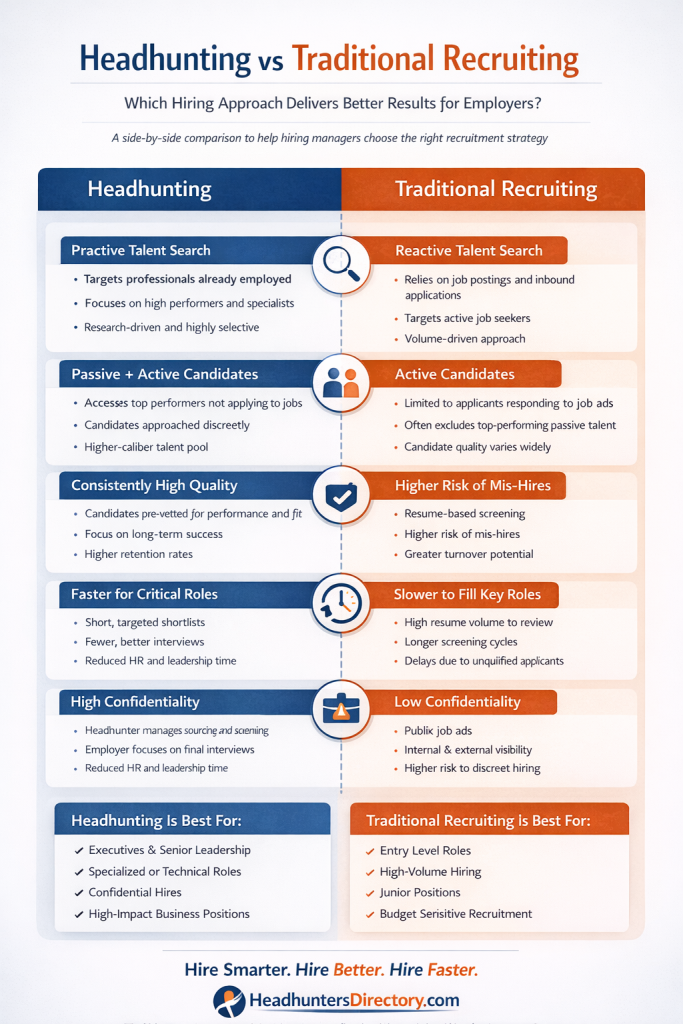
Headhunting is best for employers hiring executives, senior leaders, or specialized talent, while traditional recruiting works well for entry-level and high-volume roles. Headhunting provides access to passive candidates, higher-quality hires, faster results for critical roles, and greater confidentiality, making it ideal for business-critical hiring decisions.

Headhunting vs Traditional Hiring: Employer Benefits Explained
Hiring the right talent is no longer just an HR function. It is a strategic business decision that directly impacts revenue, productivity, culture, and long-term growth. In today’s competitive labor market, employers face tighter talent pools, higher candidate expectations, and increasing pressure to make every hire count.
As a result, many organizations are reassessing how they recruit.
Two of the most common hiring approaches are headhunting and traditional recruiting. While both aim to fill open roles, they differ significantly in execution, outcomes, and return on investment.
This in-depth guide compares both approaches from an employer and hiring manager perspective, outlines the most valuable benefits to businesses, and explains how HeadhuntersDirectory.com helps employers connect directly with proven headhunters and recruiters to hire more effectively.
Understanding the Difference: Headhunting vs. Traditional Recruiting
What Is Traditional Recruiting?
Traditional recruiting is a reactive hiring model that relies on attracting candidates who are actively looking for work.
This approach typically includes:
- Posting job openings on job boards and career pages
- Promoting roles through social media or internal referrals
- Screening inbound resumes and applications
- Interviewing candidates who apply
- Selecting the best available applicant
Traditional recruiting works best when talent supply exceeds demand or when roles require minimal specialization.
However, employers often encounter challenges such as:
- High application volume but low candidate quality
- Resume overload and screening fatigue
- Longer hiring cycles for complex roles
- Limited reach beyond active job seekers
What Is Headhunting?
Headhunting is a proactive, research-driven recruitment strategy focused on identifying and engaging high-performing professionals who are not actively seeking new roles.
Rather than waiting for applicants, headhunters:
- Map the talent landscape within a specific industry
- Identify professionals with proven performance records
- Approach candidates directly and discreetly
- Assess motivation, fit, and readiness to move
- Present only qualified, interested candidates to employers
Headhunting is commonly used for:
- Executive and C-suite roles
- Senior management and leadership positions
- Highly specialized or technical roles
- Confidential or strategic hires
This approach prioritizes quality, precision, and long-term value.
The Most Valuable Benefits of Headhunting for Employers
1. Access to High-Performing Passive Talent
One of the most compelling advantages of headhunting is access to passive candidates, who make up the majority of top performers.
Key advantages include:
- Passive candidates are often already succeeding in similar roles
- They are selectively open to opportunities, not desperate for change
- They typically bring stronger performance histories
Traditional recruiting rarely reaches this segment of the workforce, giving headhunting a significant competitive edge.
2. Substantially Higher Quality of Hire
Headhunters evaluate candidates far beyond resumes.
They assess:
- Proven results and career trajectory
- Leadership ability and decision-making style
- Cultural and organizational fit
- Long-term career alignment
For employers, this leads to:
- Fewer hiring mistakes
- Higher on-the-job performance
- Stronger retention and engagement
Over time, higher-quality hires significantly reduce rehiring and turnover costs.
3. Faster Hiring for Business-Critical Roles
Although headhunting may appear slower upfront, it often accelerates hiring for complex roles.
Why?
- Candidate shortlists are smaller and more relevant
- Interviews focus on qualified decision-ready candidates
- Employers spend less time reviewing unqualified resumes
For senior or specialized roles, headhunting frequently delivers faster and more predictable outcomes than traditional recruiting.
4. Confidential and Low-Risk Hiring
Many hiring scenarios require discretion, including:
- Replacing underperforming leaders
- Building new departments
- Mergers, acquisitions, or restructuring
- Succession planning
Headhunters protect employer confidentiality by:
- Conducting discreet outreach
- Avoiding public job postings
- Managing sensitive conversations professionally
This minimizes internal disruption and market speculation.
5. Strategic Market Intelligence for Employers
Beyond filling roles, headhunters act as talent market advisors.
They provide insight on:
- Compensation benchmarks and expectations
- Talent availability and scarcity
- Competitor hiring activity
- Role feasibility and skill trade-offs
This intelligence allows employers to refine job requirements, adjust compensation strategies, and improve hiring success rates.
6. Reduced Internal Time and Resource Drain
Hiring is expensive in terms of internal time.
Headhunters take ownership of:
- Talent research and sourcing
- Initial screening and qualification
- Candidate communication and scheduling
- Offer management and negotiation support
This allows HR teams and executives to remain focused on core business priorities.
7. Stronger Employer Positioning in Competitive Markets
When top candidates are approached professionally, the employer brand benefits.
Headhunters ensure that:
- The opportunity is positioned strategically
- Employer messaging is clear and compelling
- Candidates experience a high-touch, respectful process
This is especially important when competing for scarce or in-demand talent.
Key Benefits of Traditional Recruiting for Employers
While headhunting excels in many areas, traditional recruiting remains valuable in specific scenarios.
1. Lower Initial Recruitment Costs
Traditional recruiting typically involves:
- Job board fees
- Internal HR time
- Minimal external agency involvement
This can be cost-effective for roles with high applicant availability or lower business impact.
2. Suitable for Volume and Entry-Level Hiring
Traditional recruiting works well when:
- Hiring multiple similar roles
- Recruiting junior or early-career professionals
- Scaling operations quickly
In these cases, applicant volume can be an advantage.
3. Greater Internal Control Over Hiring Decisions
Some employers prefer managing recruitment internally due to:
- Established employer branding
- Strong internal recruitment teams
- Predictable talent pipelines
However, internal control often comes at the cost of reach and speed for specialized roles.
Headhunting vs. Traditional Recruiting: Side-by-Side Comparison
| Factor | Headhunting | Traditional Recruiting |
|---|---|---|
| Candidate Type | Passive and active | Mostly active |
| Talent Quality | Consistently high | Varies widely |
| Time to Hire | Faster for senior roles | Slower for complex hires |
| Confidentiality | High | Low |
| Strategic Insight | Strong | Limited |
| Best Use Cases | Executives, specialists, leadership | Entry-level, volume hiring |
Cost Considerations: Short-Term vs. Long-Term ROI
While headhunting often involves higher fees, employers should evaluate total cost of hire, not just recruitment expense.
Headhunting reduces costs associated with:
- Poor hiring decisions
- Early employee turnover
- Productivity ramp-up time
- Repeated rehiring cycles
For business-critical roles, the long-term return on investment frequently outweighs the initial cost difference.

Headhunting vs Recruiting: Key Benefits for Hiring Managers
Which Hiring Approach Is Right for Your Business?
Headhunting Is the Best Choice If You Are:
- Hiring executives or senior leaders
- Facing a shortage of qualified candidates
- Operating in a competitive or specialized market
- Making confidential or strategic hires
- Focused on long-term performance and retention
Traditional Recruiting Is Suitable If You Are:
- Hiring entry-level or junior roles
- Recruiting at scale
- Working with limited budgets
- Receiving strong inbound applicant flow
Many organizations successfully use both approaches, depending on role complexity and business impact.
Why Hiring Managers Trust HeadhuntersDirectory.com
Choosing the right recruitment partner is just as important as choosing the right hiring strategy.
HeadhuntersDirectory.com is the hiring manager’s most effective resource for connecting directly with professional headhunters and recruiters across industries and locations.
Key Advantages for Employers
- Direct access to experienced headhunters and recruiters
- Search by industry, role specialization, or geography
- No unnecessary intermediaries
- Faster connection to the right recruitment experts
- Ideal for executive search, confidential hiring, and specialized roles
Instead of relying on generic job boards or unsuitable agencies, hiring managers can quickly identify recruiters who understand their exact hiring needs.
Making the Smarter Hiring Decision
In today’s talent-driven economy, hiring is a competitive advantage.
While traditional recruiting remains effective for certain roles, headhunting consistently delivers superior results when quality, discretion, and performance matter most.
For employers seeking better hires, stronger teams, and long-term growth, working with experienced headhunters is often the smartest decision. HeadhuntersDirectory.com simplifies that process by giving hiring managers direct access to trusted recruitment professionals who deliver results.
When the role truly matters, the way you hire matters even more.
The Ultimate Guide to Choosing the Right Recruiter for Your Career or Company
How to Partner with a Headhunter as Employers and Hiring Managers
What to Expect When Working With a Headhunter
Why Geography Still Matters in Hiring
Even in an age where remote work and global hiring dominate headlines, local recruiters remain unmatched in their ability to connect people and opportunities within their communities. Their local knowledge, relationships, and personal touch lead to better outcomes for both employers and job seekers.
Whether you are trying to fill an important role or take the next step in your career, working with a local recruiter gives you the advantage of insight, speed, and genuine human connection.
Start your search today at HeadhuntersDirectory.com and experience how local recruiting can make your next hire or career move the best one yet.
Visit HeadhuntersDirectory.com today to connect with trusted recruiters, headhunters, and executive search firms across the USA, Canada, the UK, and Australia. Find your match, grow your network, and discover opportunities you didn’t even know existed.

- How Executive Recruiters Unlock Jobs You Will Never Find Online

- 10 Signs It’s Time to Leave Your Job Even If the Money Is Great

- How Recruiters Actually Read Your Resume in 30 Seconds

- 10 Reasons Why Recruiters Never Call Qualified Candidates

- 12 Things You Should Never, Ever Say to Your Boss

- Why Networking Still Beats Applying Online

- What Recruiters Wish Every Candidate Knew 15 Insider Tips for Job Seekers

- Why Applying to Hundreds of Jobs Rarely Works

- The Complete Guide to Recruiter Red Flags